

![Three Problem Attributes [LC32]](/content/images/size/w30/2026/02/product-problem-ternary-focus--1-.png)
Starting with the base condition, one or more people are working on something, and there is a situation you deem a problem. For some reason, you wish it were moving differently.
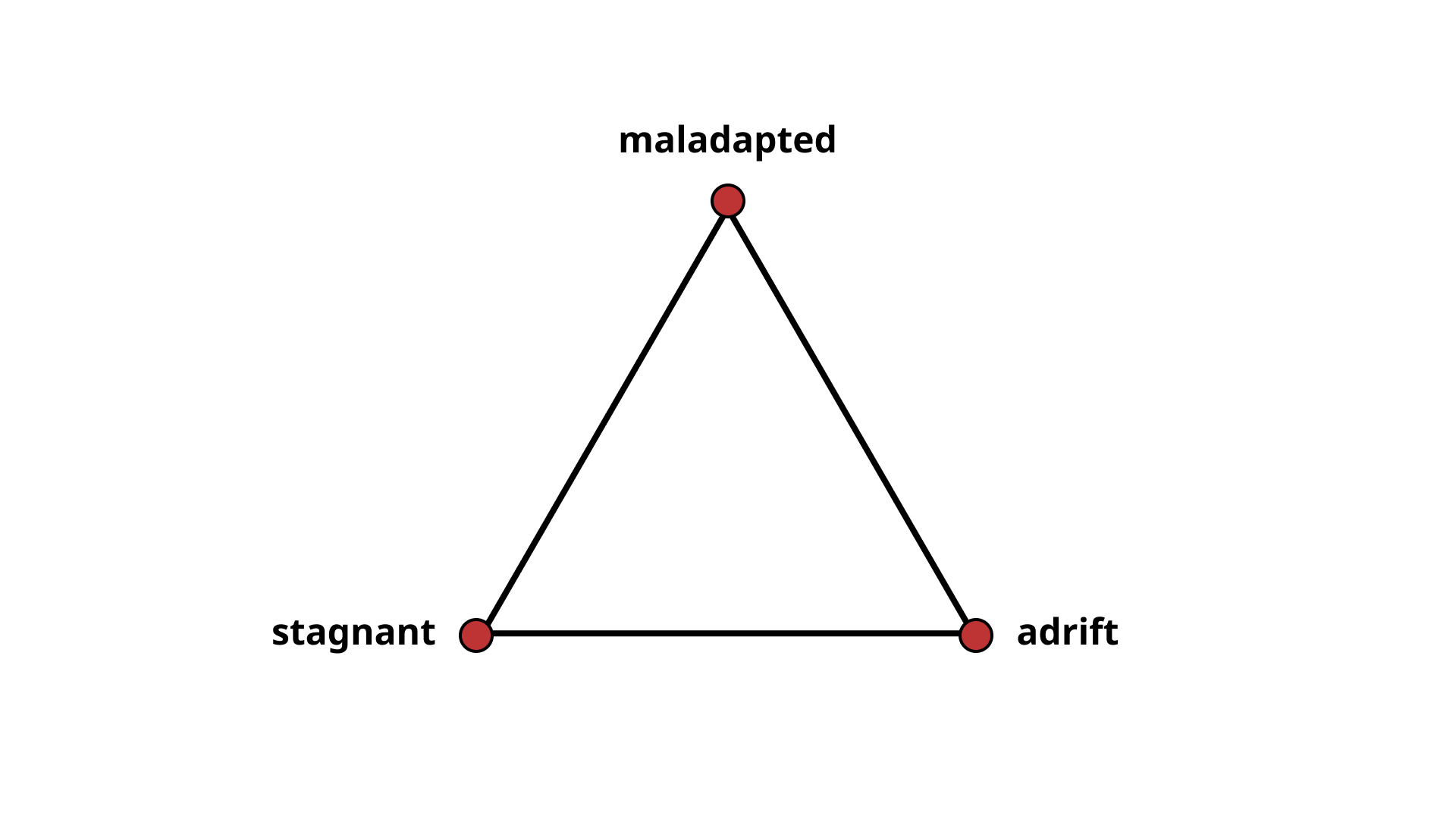
You can consider that situation in terms of its primary attribute: stagnant, maladapted, or adrift
- Stagnant situations: the team is pointed in a useful direction and equipped to handle the work, but they aren't moving the situation forward or seeing progress.
- Maladapted situations: the team is making progress in a reasonable direction, but they aren't working reliably or able to adapt how they work.
- Adrift situations: the team is moving forward, and well enough, but they aren't going in an aligned or well-considered direction.
The right perspective is important to get a handle on the problem. Each scope of awareness operates on a different view of the situation simultaneously. Consider the product squad, the design system group, the product planning cycle, the engineering manager, the leadership team, or the release process — each reveals a different take on what is important and what is possible in the same situation.
Imagine placing the problem on the triangle below. Consider what is most important to repair next: is it traction and motion (stagnant), approach and reliability (maladapted), or direction and anticipation (adrift)? You're not making a strict categorization, but a momentary prioritization.
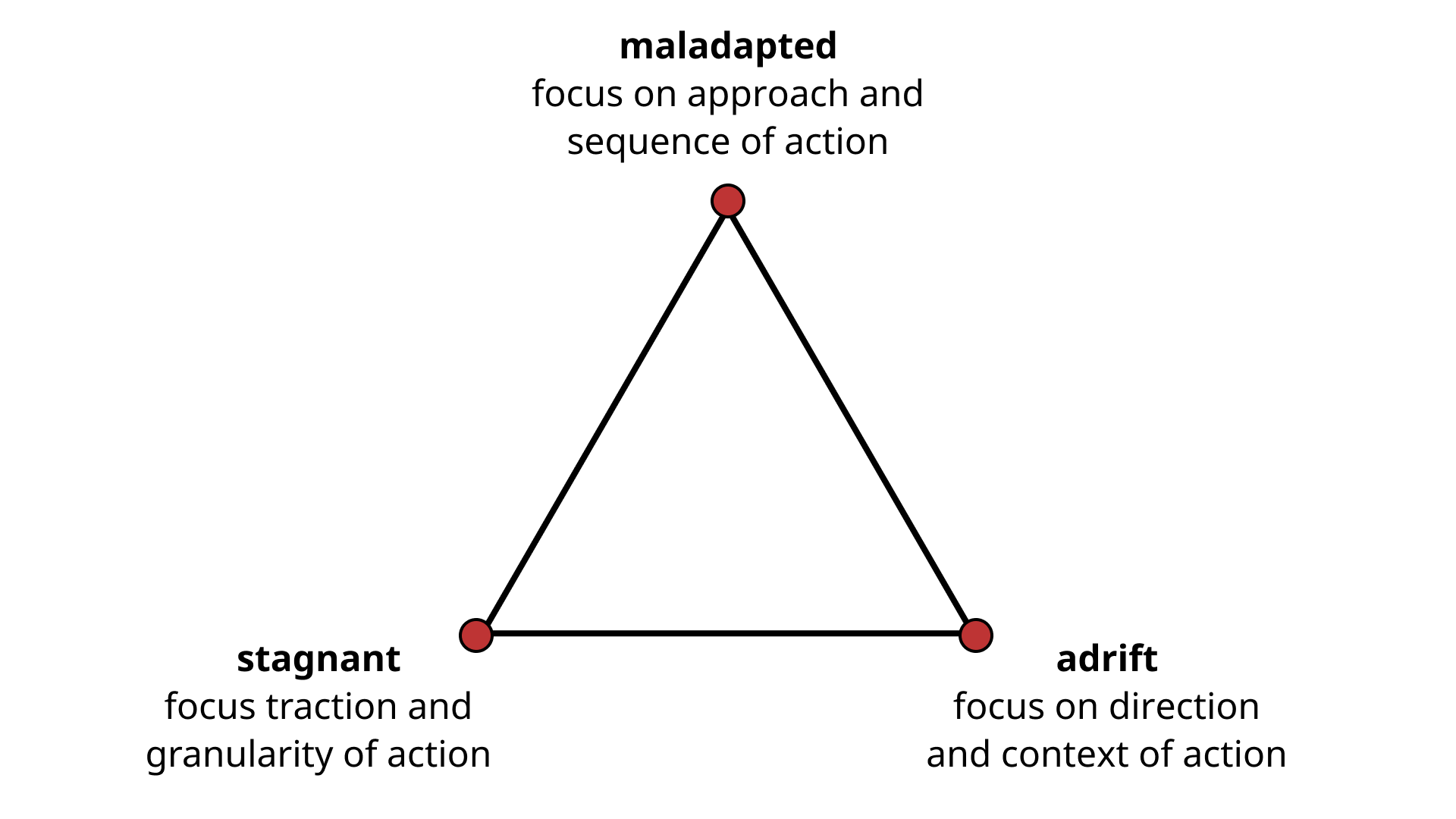
All three attributes exist in your problem. One or perhaps two are dominant, and you can only act on one at a time. The re-org feels like a fresh start that will cut the worst of knots, and succeeds in damaging traction, approach, and direction all at once. (The city is not a tree, and neither is the product org.)
No boundary that you draw will cleanly capture the problem, and your own understanding will adapt and shift as you work with it. When you place the problem, however you frame it now, the dominant attribute suggests a mode of approach.
- In stagnant situations, you focus on traction and granularity of action. You probably need to reconnect the team to external context and re-focus on user reality. You try to model opportunities for action and take concrete steps forward, adapting and learning in increments.
- In maladapted situations, you focus on the approach and sequence of action. You probably need to depict the team's work and create shared frames of reference. You try to break down its loops and cycles and re-adapt its recurring sequences where they are most damaged.
- In adrift situations, you focus on direction and context of action. You probably need to re-evaluate the situation in its context. You try to anticipate future change across levels of scale, rebuild a common language where communication is failing, and balance your portfolio of effort.
No matter its primary attribute, the structure underlying the situation is quite human. Awareness goes stale, perspectives diverge, timescales misalign, intent decays, and the landscape shifts. Working on the problem is step-by-step travel, each step a cycle of action and re-articulation of the situation.
That travel goes much better with a map or a model — tangible, shared, and adaptable — rather than text or a story to guide the way. In a firefighting scenario, the sand table is straightforward. It physically reflects geological survey, satellite imagery, fire conditions, and climate. In product scenarios, our tools, frameworks, metrics, objectives, and methods all show a glimpse of the problem, while their volume and self-insistence obscure how it emerged in the first place.
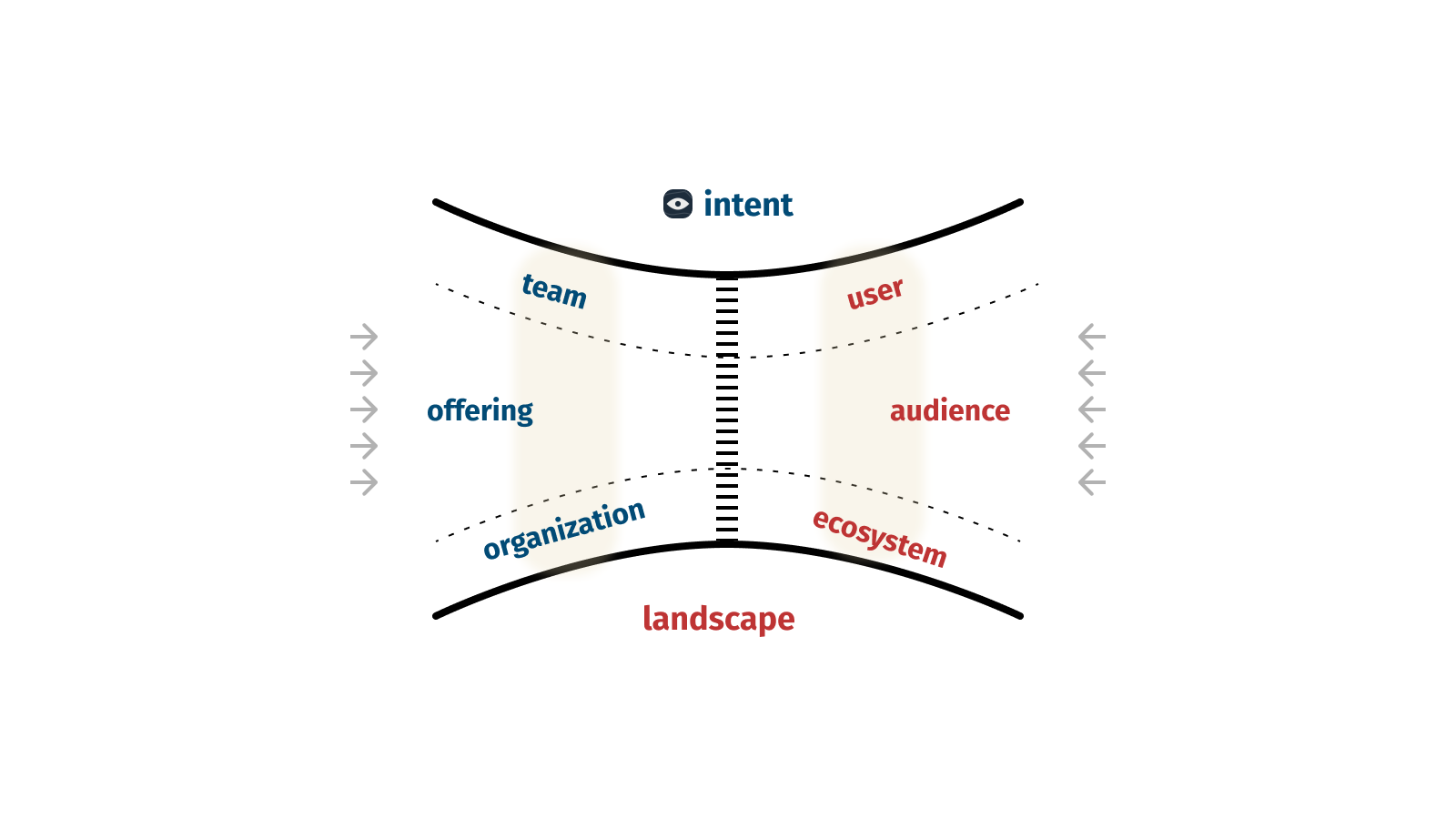
You know the major attribute of the problem. Next, you need to find its edges and uncover the relevant and actionable parts. The framework is meant to illustrate how, depending on the type of problem you're working with. We'll keep working on it in future updates.
Until next time—
![Seeding a Product Framework [LC31]](/content/images/size/w30/2025/12/full-framework-thumb--1--1.png)
![Maintenance Required [LC30]](/content/images/size/w30/2025/09/Screenshot-2025-09-01-at-17.23.00-1.png)
![Vineyard and Complexity [LC29]](/content/images/size/w30/2025/08/marco-vines-1.png)