


If you are a in a product organization and leading a team, a project, a program, or a division, you are playing the product game.
You may not need to engage with this game if your scope is limited to technical expertise, or your footprint of formal authority exceeds your organizational awareness. Most people in product organizations leave the former condition within a year or two of work; my rude awakening is recounted as the opening of the Researcher's Journey. Only a few are cursed — or blessed, depending on your perspective — with the latter.
In between, where you and I are stationed, we are playing the product game. Or, more appropriately: we are playing interconnected, context-constrained, and relationship-based sub-games on a massive, unseen playing field.
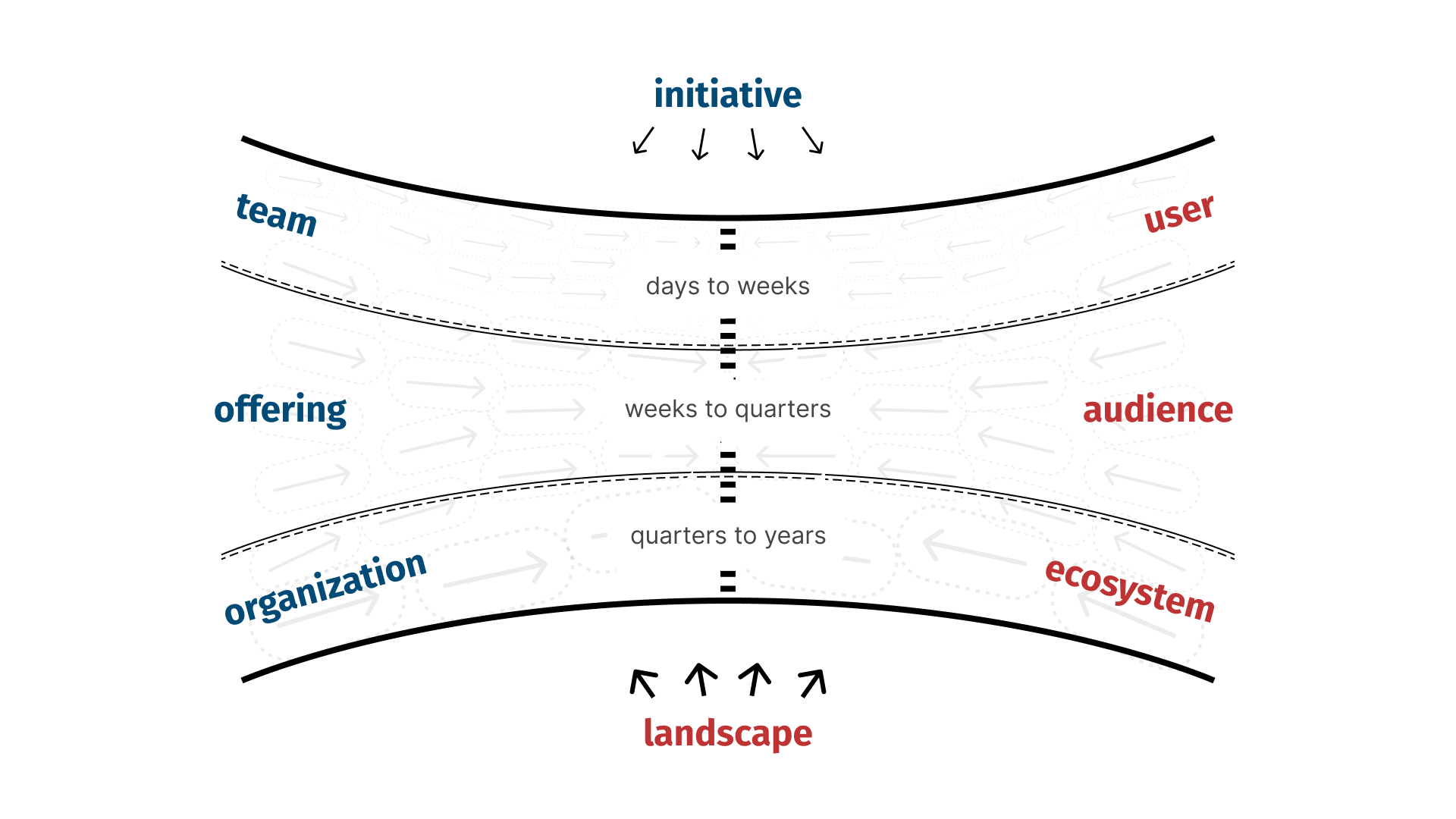
That field can be represented as above. (Gone is the "background snapshot", if you were here in the prior weeks.) This playing field comprises timescales and contexts and domains of order and rituals and interactions and capital and stages of evolution and people and teams. The field is massive: you will never be able to grasp all or even a portion of it, and every game, as the player sees it, is local and contextual. Within the breadth of the field, the upper and lower bounds of each game are determined by the player's conception of the initiative at hand, and the relevant landscape.
Last week, we looked at timescales of play. Every player inhabits a primary timescale, determined by the rate of change in the major centers they care about (which are bounded by initiative and landscape.)
A walker, a cyclist, and a driver engaged with their respective locomotive tools, have entirely different experiences of the same city. The walkers, with fine-grained attention, see the things that change day-to-day or week over week. Drivers who move down the main routes of travel have coarse-grained attention to the city; they see things that change over months, quarters, or years.
The same for players of the product game: different concepts, tools, and signals are used for navigating different timescales. They work at different granularities. They shape players' experience of the game, and their perception of available options for play.
Field sense includes other players' field sense
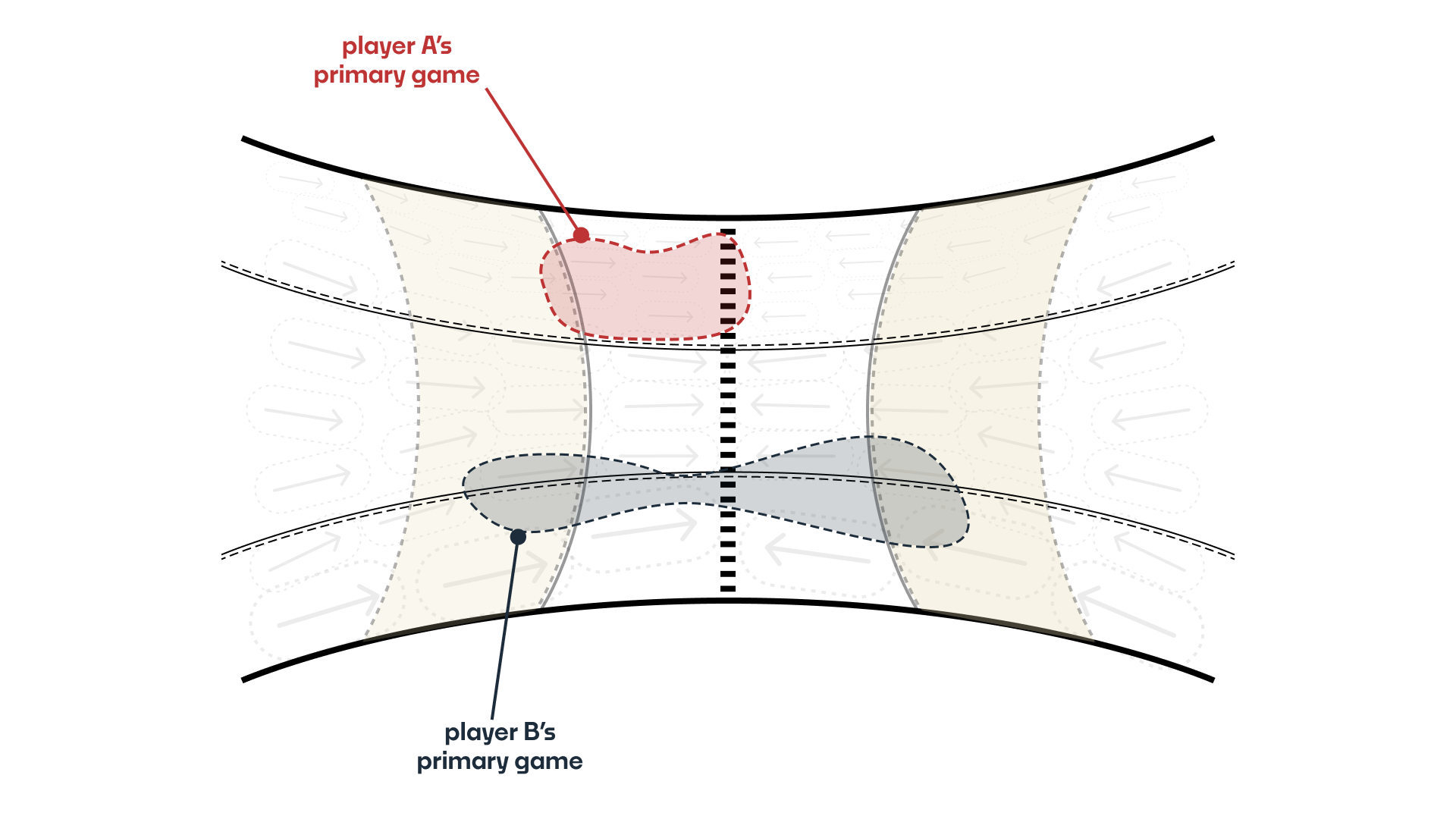
In the sketch above, imagine player A as a junior designer, and player B as a head of product. Last week we saw the limited overlap in field awareness from a player's-eye-view. Here, the notion of a shared playing field lets us localize players' primary place of play relative to one another.
Timescale boundaries prevent players from anticipating events outside of their own local games. From last week:
The boundaries between each timescale are porous, but they also dramatically filter the view of other areas. Adjacencies are visible, and the larger the organization, the more these boundaries between timescales become barriers or protective bubbles of awareness.
It's easy to blame the players of faster-cycle games (closer to A) for overlooking the predictable slow-cycle events (closer to B). Consider how annual planning cycles, predictable events with dates set out quarters or a year in advance, waylay unsuspecting players who don't see them coming every year — over and over again. Leaders who live and breathe the slow time scale see these events coming and feel them as a part of their natural rhythms. Players of finer-grained games, where things change more quickly do not see and feel annual planning cycles as part of their natural rhythms — to do so is a distraction. Good leaders understand the footprint of their team's field sense, and augment that awareness with deliberate communication and right-sized on-ramps into slow-cycle activities.
To have good field sense, you need to know the other players' games and their scope of awareness. This is a moving target, difficult to get a hold of, but to overlook it is doing a dis-service to one's own team. Consider the product executive who, quarter over quarter, only seems to remember they need new dashboards and well-considered progress updates from their team for the next board meeting... which is two days from now. Who should have seen it coming?
Beyond timescale
After the coupling of internal and external, the two sides of the playing field, timescales create the next-most important dynamic to get a handle on: simple and crucial. The field also has three vertical bands on the internal side, and three vertical bands on the external side. These represent places of play similar to those introduced in the structure of user experience, but evolved to account for complexity threads. These three aspects are the core of good field sense.
We'll explore them here, down the road, after we get more clear on the rules of the game.
Other things of note
- I updated the newsletter name: "playing the background" was abstract and unfamiliar; "the product game" paired with a visual playing field invokes some familiar dynamics of play. And the hook is cleaner: if you are reading this, you have been (and probably are) inside an organization where it feels like team members are playing entirely different games than you are. And they are, so you better recognize how that works.
- The 'field' of play will do double work for us: Alexander describes the mathematical structure of wholeness as a "field of centers." We'll draw on this again when we dig into affordance for action and the limitations individual player's awareness.
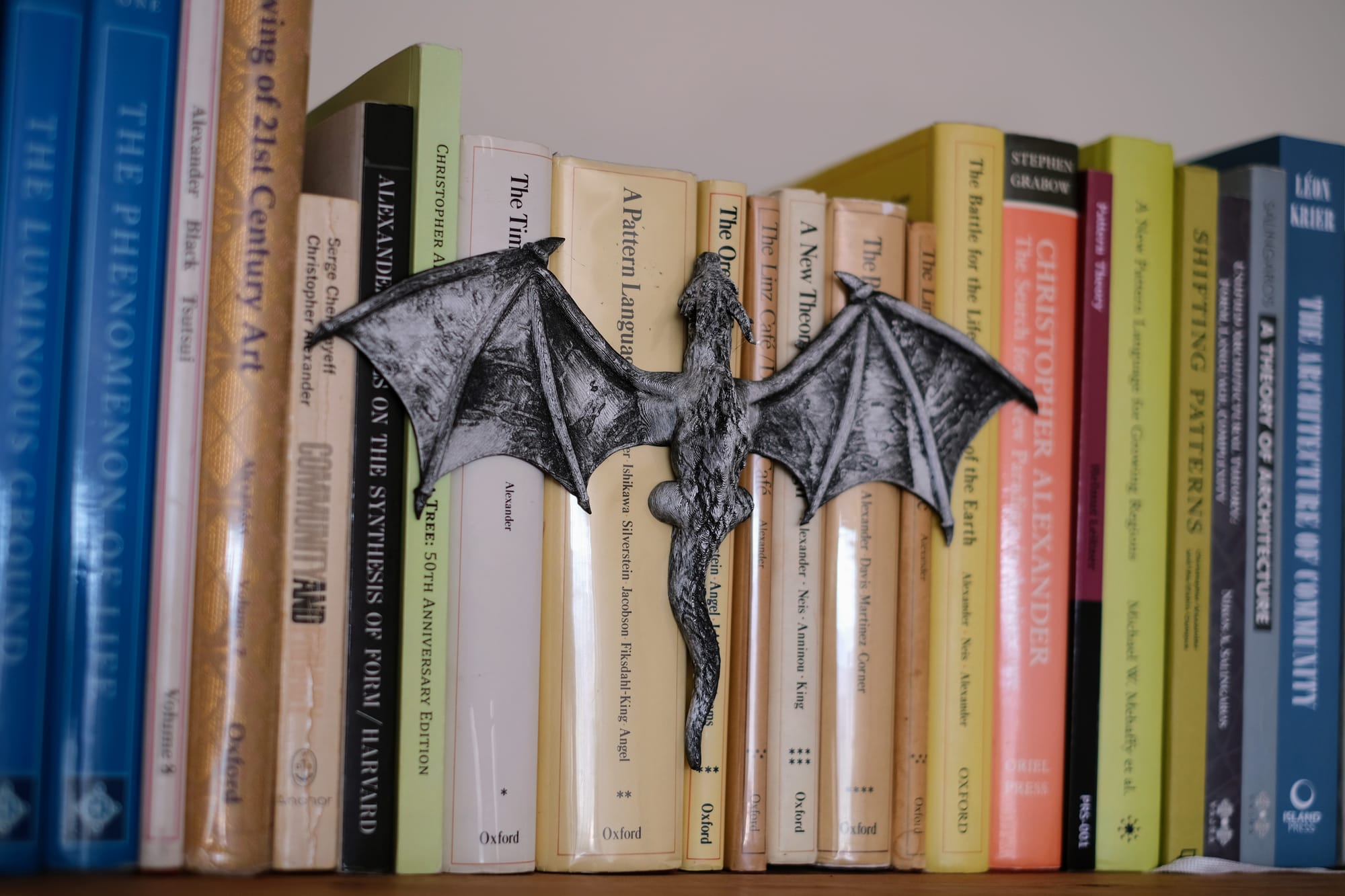
- I am the proud owner of a book dragon. Pictured below, it is currently guarding the CES volumes of Christopher Alexander's work.
Until next time—
This is The Product Game, a newsletter for players in the product organization. Whenever you try to adapt or improve the situation, you're playing the product game.


