


The aim of playing the background is changing others' options for action — and eventually, but indirectly, behavior — by adding, removing, or adapting the structural centers that constitute their view of the situation. I use centers* (see note) as in 'centers of attention' or 'centers of influence' — any kind of "focal point in a larger, unbroken whole" that can be perceived and offer some affordance for language, thinking, or activity.
You can only play the game well if you have a sense of what exists in the other players' background: that is the game board that dictates what options they perceive and how they respond. It will be different from the background that you see and experience.
So far, we have pictured that difference like the image below. While it makes the point, it does a disservice to what other players in the game are actually seeing and experiencing.
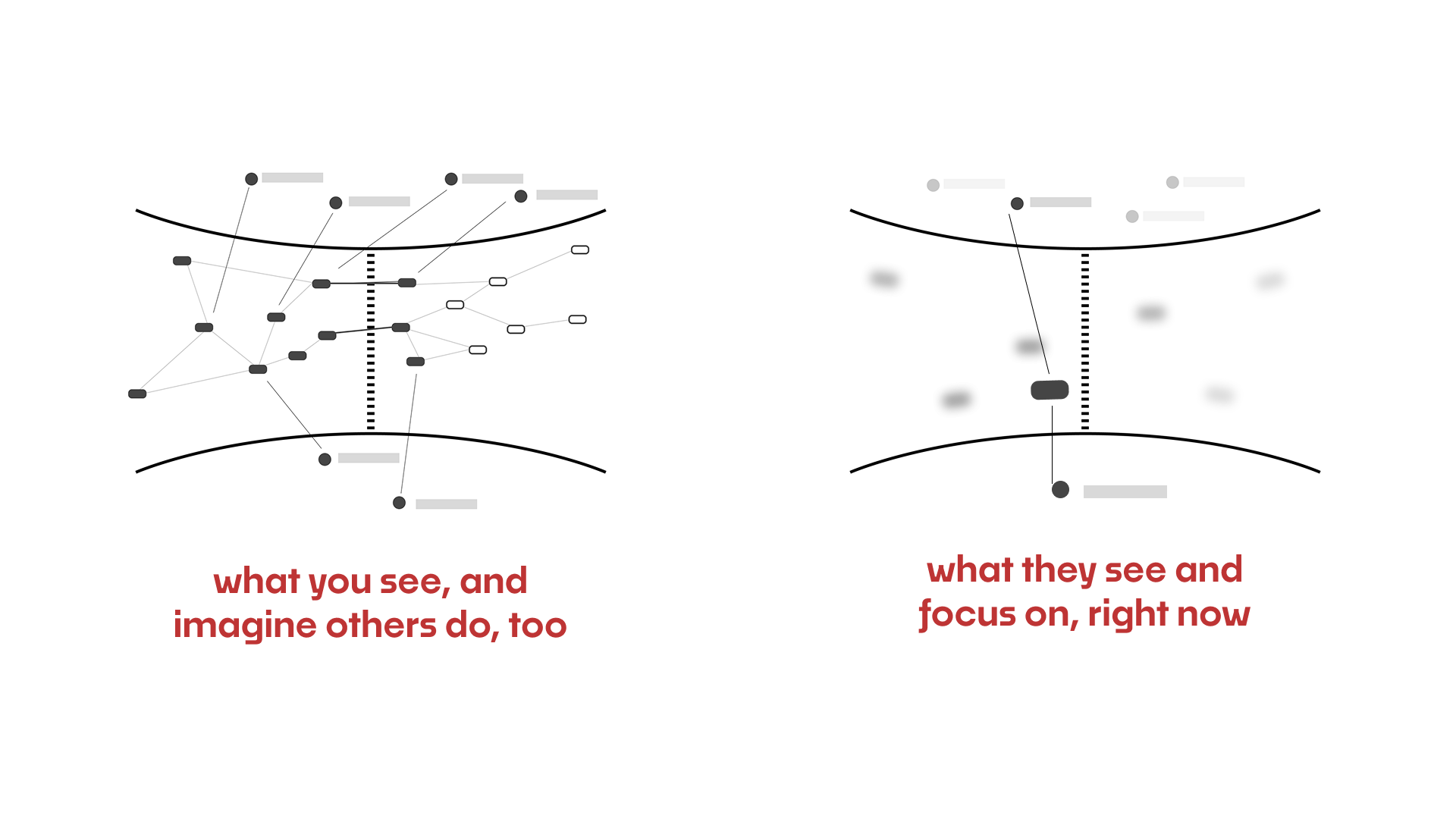
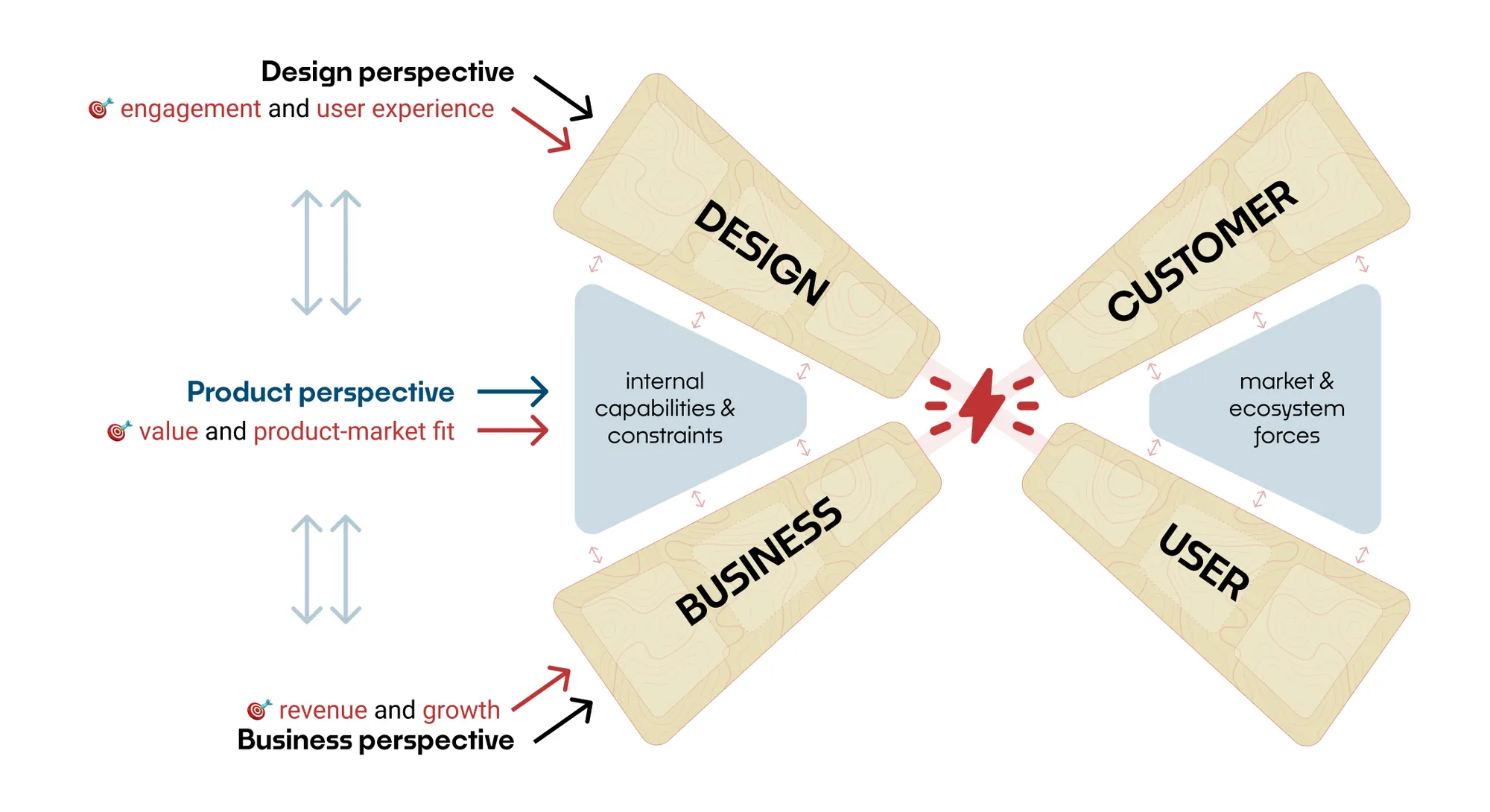
Their understanding of the background is, in reality, just as rich and complex as your own, if not more so. But it is a different background. Some times, this difference is a matter of functional perspective and its associated language: the reason that John Maeda told me designers "smell funny" to business people.
Other times, that different understanding of the background is due to the difference of each player's primary timescale, and its associated perspective. In my work I pay close attention to three of them: team<>user, offering<>audience, and organization<>ecosystem. (As in any kind of pace layering, you can draw the lines wherever you like.) They are horizontal slices of the interaction between internal potential and external opportunity, like so:
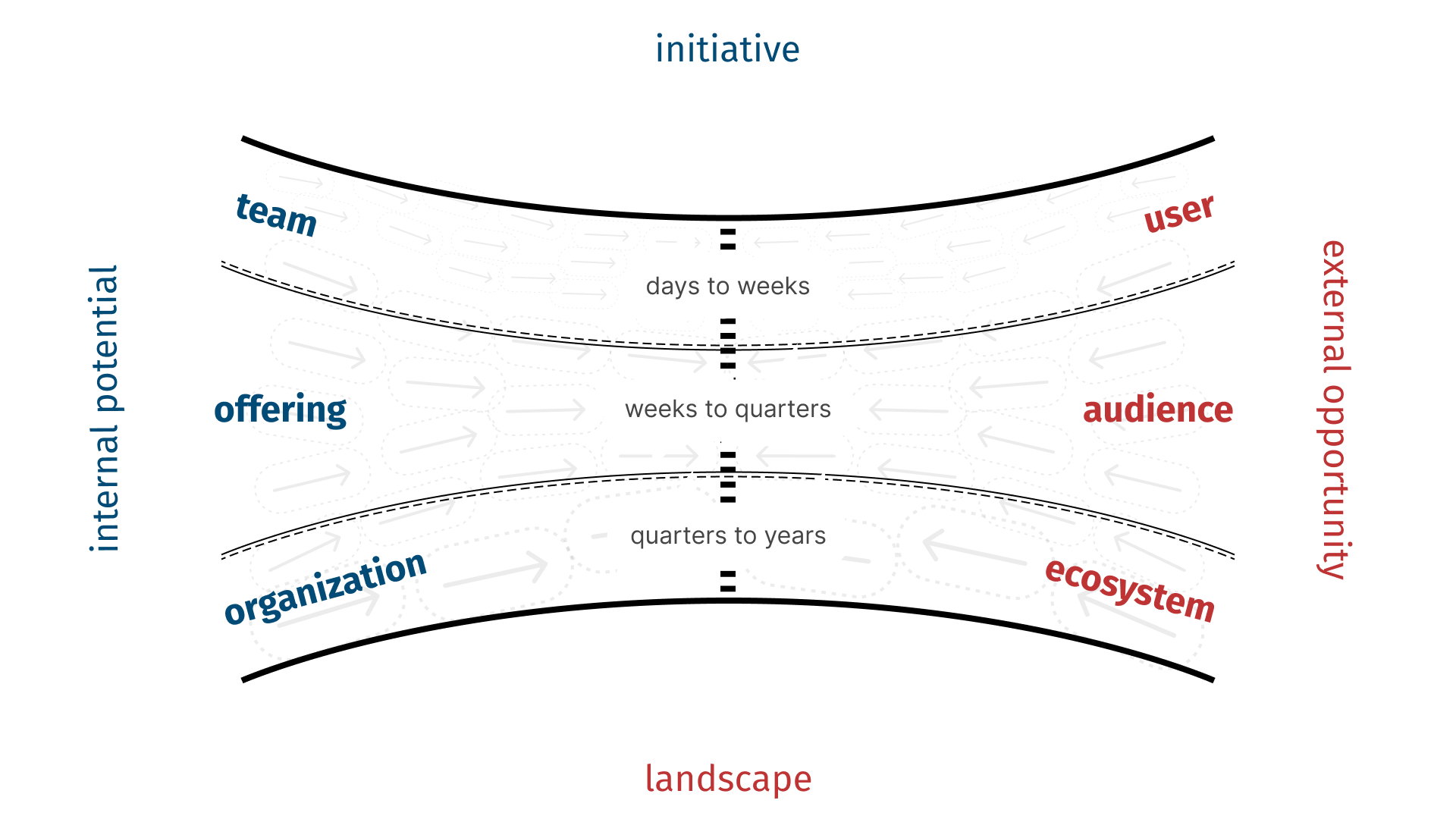
Depending on the size and context of your organization, the time scale boundaries and bands of duration will differ. You will need to explore all three to build a balanced view of the situation. The players involved each inhabit a primary timescale that defines their view of the situation. The boundaries between each timescale are porous, but they also dramatically filter the view of other areas. Adjacencies are visible, and the larger the organization, the more these boundaries between timescales become barriers or protective bubbles of awareness.
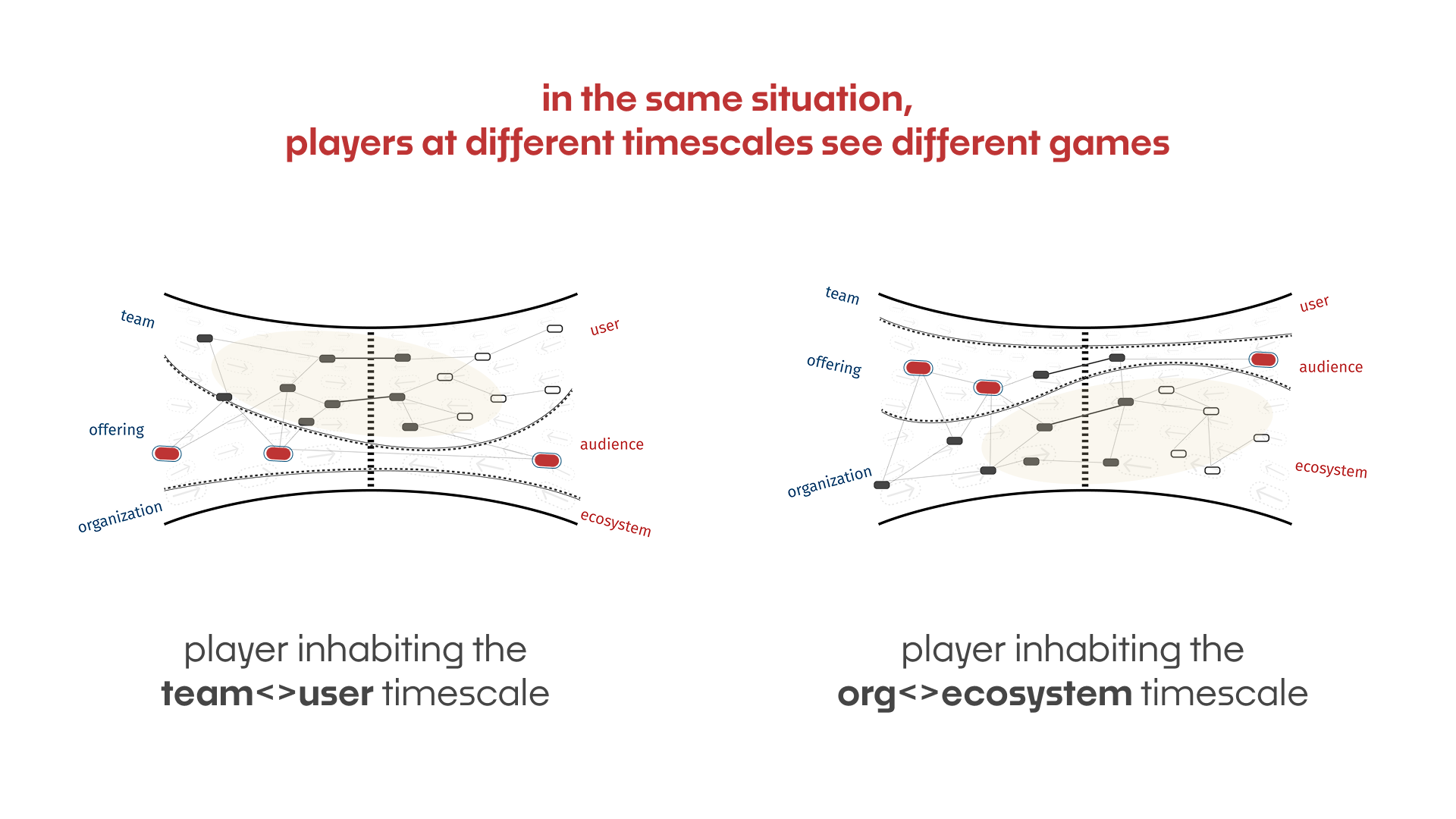
In the same company, the senior designer, the staff engineer, and the VP of product inhabit different worlds. Each timescale dictates the steps and moves players see as available, and the language they use to describe them. Activities and patterns of action are different; ritual cycles have different operating windows, lead times, and half-lives. When things are working well, there is a common language — these worlds at different timescales talk to each other.
When the hard problems emerge, the background that [theoretically] collaborative players are working from diverge so far that they seem to be playing entire different games.
The best approach to bridge the timescale barriers is to model critical context to expose it for discussion. It's why firefighters use sand tables, Simon Wardley developed Wardley Mapping, the Cynefin Co. built Estuarine Mapping, Crown & Reach built Multiverse Mapping, Dave Gray works on Visual Frameworks, Studio D teaches Framework Darwinism, and smart people everywhere use visual models to depict journeys and needs and flows and scenarios and any other element of strategy that is important to work with.
The moment you get other players to argue, in the productive sense, about a good model and to adapt it, you are loading new centers of attention into collective understanding. You are giving them a way to see and explore new options for action that may have always existed, in some objective sense, but were never truly available, because they were not available on that players' game board.
Other things of note
- *The term centers is from Christopher Alexander's Nature of Order, volume I. A center salient to the problem in a product organization may be an artifact, a routine, a workflow, a meeting room, a deployment process, or an interface. Anything you can think about is a center, though only a small subset of them will be interesting for a given problem. (The hard part is nailing down the right ones, at appropriate granularity.)
Compare centers to capital in Wardley Mapping, or Actors-Constraints-Constructors in the Estuarine framework — they are the pieces on the board you play with. I wrote about them on Architexturez and David Seamon approached them in The Side View. They are the solitary structural element in Alexander's cosmology: interlocking, overlapping, composed-of and composing other centers. As we examine problems in the product organization, centers will be our basic unit of analysis. From Alexander, as quoted by Seamon:
...all these troublesome entities . . . were not truly entities but were in fact non-bounded centers: Centers of influence, centers of action, centers of other centers—centers of some kind, appearing in the seething mass of wholeness . . . I finally realized that this way of looking at things was logically consistent, solved all the earlier problems of “entities,” and was a solid footing on which a theory of order could be properly built.
- My dear departed grandfather called his hearing aids "ear glasses."
Until next time—
This is The Product Game, a newsletter for leaders in the product organization. Whenever you try to adapt or improve the situation, you're playing the product game.


