


As you enter a game inside the organization, trying to make sense of it and figure out where to play next, you need to understand its context (last week: wide angle view) and the structure of the playing field.
You also need to follow the sequence of play inside that game, too.
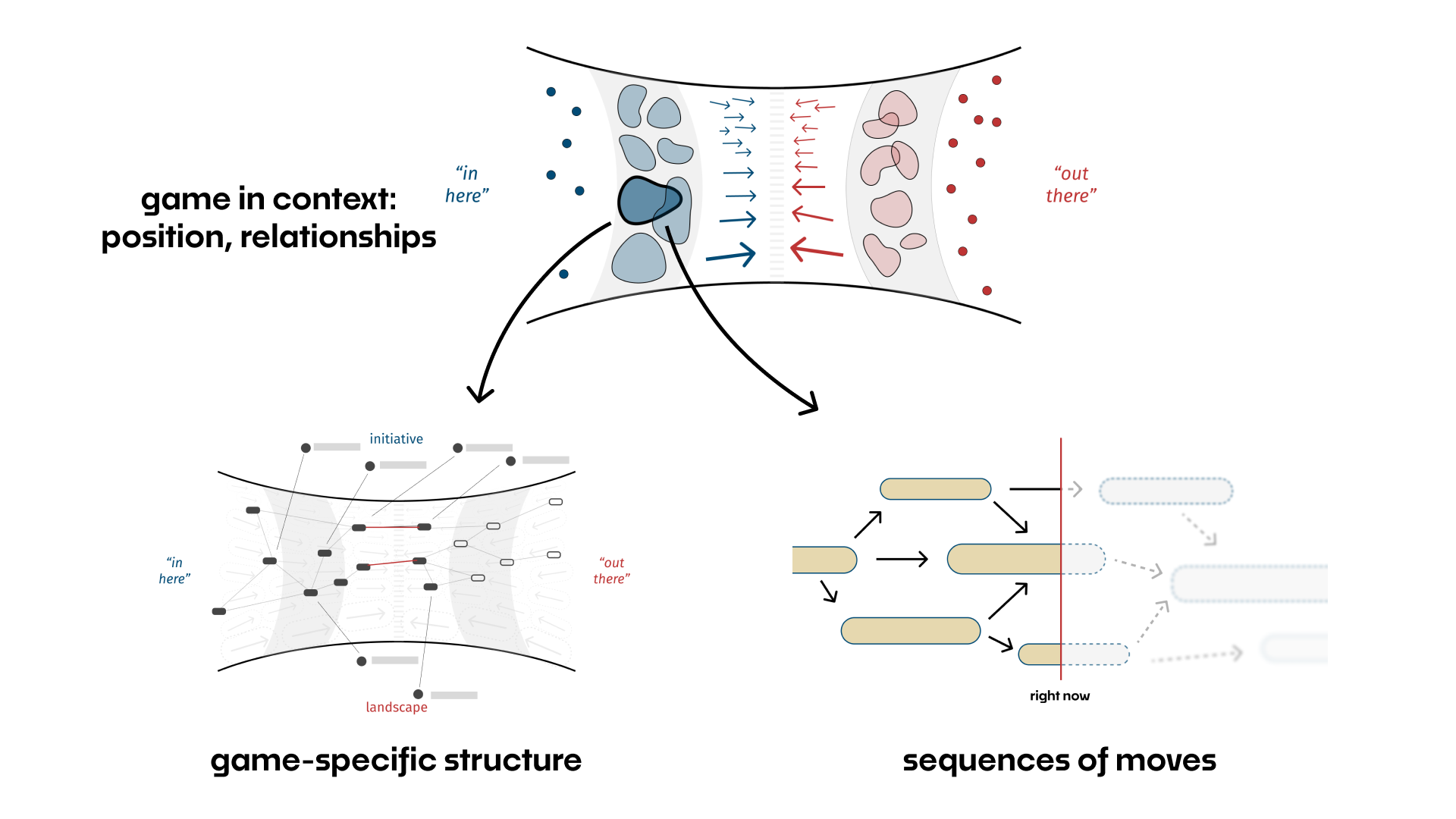
The game-specific structure is quite tangible. We define that in terms of concrete centers of activity distributed throughout the playing field, across different timescales, as understood by players and involved observers. (Later on, we'll look at the typology that helps enumerate those centers: concrete/tangible, embedded/embodied, and enacted/occurring. In the wide-angle view we collapse those types into three specific instances, even as the frame zooms out: players, games, and moves.)
You also need to find and follow the sequence of play. Sequence and structure interact: finding the sequence will reveal structure and expose how other players see the field — what they recognize as possible and where their play is leading. The first point of investigation hearkens back to the fundamental question, this time pointed at an internal game and its players: what are they doing right now? Just as our view of structure in play must snap down into concrete granularity on the playing field, our view of sequence must also snap down from abstract processes into specific and granular moves and steps.
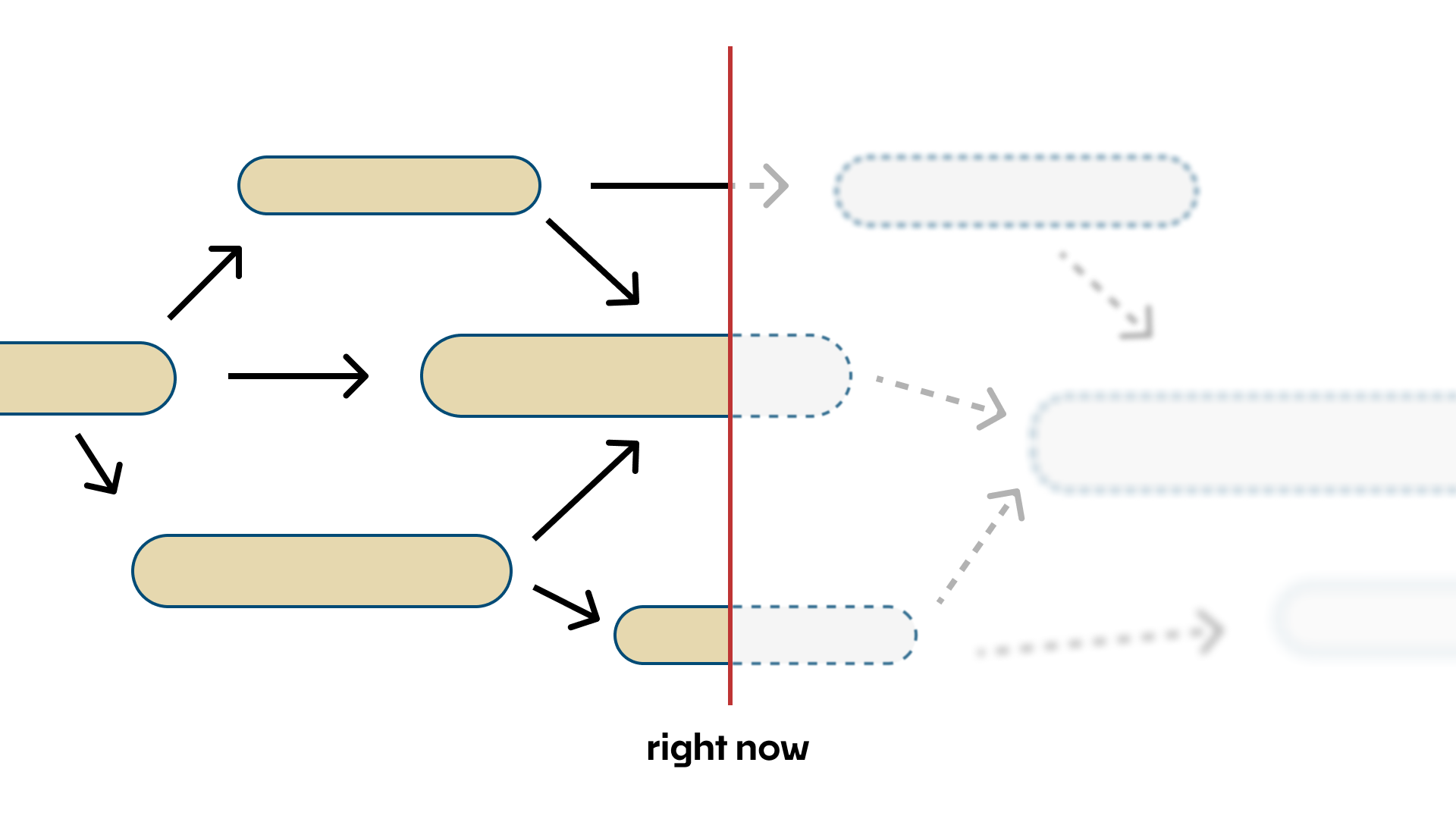
Sequence carries three points in time: now, before, and next.
What are they doing right now? You start with 'now' because it is concrete, available, and unavoidable. When I say 'the sequence of play' you may consider the high level moves that a game emits to the larger field, and look at what is being built and why. If you enter the game and want to improve it or adapt it, you also need to look at the steps that are underway right now, and their sequence, within the scope of the moves they support. Steps are the actions building the next move: they are, and will remain, opaque to any who are not playing inside that specific game. How players take steps, and the moves they are targeting, reveal relevant structure and also expose the internal agreements or limits of visibility which determine what is 'in play.'
What happened before, what led us here? You also need to explore 'before.' Games and players have memory and prior experience of play. Current play is driven by historical trajectory: prior moves have set the scene. Each players' experience of their delivery and the response of larger and adjacent games dictate how play is unfolding now. Imagine a team that is taking a big bet, right now. The meaning and likely success of that play is quite different if they've taken a similar, failed bet before and felt they couldn't deliver because they didn't have enough time, and now they want to 'do it right once and for all', versus a team that has taken small steps of groundwork and feel that they have 'finally enabled this next move.'
What are they going to do next? Also crucial to the sequence of play is to see where the current game thinks it is heading. Unhealthy and self-sealing games (previously self-fulfilling projects) don't articulate a new or different end-state. Good play repairs damage or enables new possibility; poor play exists for its own sake. You won't hear it in words so blunt, but you will often find that the reason we need to complete the navigation redesign project is because the navigation needs to be redesigned, or that we need to sell into a certain market is because it is currently available... whether or not is helpful or advisable. If players don't commit to the next moves or opportunities their current moves are enabling, they don't need to evaluate whether or not their current play is actually making progress toward changing the field of play accordingly.
Sequence is also where skill and tacit knowledge enter the game. Sometimes players are taking certain steps, or making certain moves, because they simply haven't built the experience or skill to guide their play for the better. From our patron saint Christopher Alexander:
We may understand it best by comparing the work of a fifty-year-old carpenter with the work of a novice. The experienced carpenter keeps going. He doesn’t have to keep stopping, because every action he performs, is calculated in such a way that some later action can put it right to the extent that it is imperfect now. What is critical here, is the sequence of events. The carpenter never takes a step which he cannot correct later; so he can keep working, confidently, steadily.
The novice by comparison, spends a great deal of his time trying to figure out what to do. He does this essentially because he knows that an action he takes now may cause unretractable problems a little further down the line; and if he is not careful, he will find himself with a joint that requires the shortening of some crucial member – at a stage when it is too late to shorten that member. The fear of these kinds of mistakes forces him to spend hours trying to figure ahead: and it forces him to work as far as possible to exact drawings because they will guarantee that he avoids these kinds of mistakes.
The difference between the novice and the master is simply that the novice has not learnt, yet, how to do things in such a way that he can afford to make small mistakes. The master knows that the sequence of his actions will always allow him to cover his mistakes a little further down the line. It is this simple but essential knowledge which gives the work of a master carpenter its wonderful, smooth, relaxed, and almost unconcerned simplicity.
— A Pattern Language (1979). Pattern #208 "Gradual Stiffening"
Other things of note
- Last week I finished reading Ursula K. Le Guin's Lathe of Heaven (goodreads link). I often return to Alexander's 1996 lecture at ACM OOPSLA (youtube link, 33:30 timestamp). He tells a room full of computer scientists that the great failure of our time is that profound feeling is dropping out of the world. He jabs at them, saying their development of object-oriented programming, inspired by his own Pattern Language, is a neat-trick but misses the point: patterns are made to carry and improve the feeling of life in whatever they build. He calls out his own profession of architecture, of course, saying that architects no longer create places and structures that introduce this profound feeling into the world. Reading Le Guin, in the later books of Earthsea and especially in Lathe, that same kind of profound feeling that Alexander is chasing wells up from the deep — emerging simply from the sequence of words she has put down on the page.
- Dave Snowden is revisiting foundational thinking in the Cynefin blog, and in CBI KM 2/3: map before you manage, I am musing on those domains where tacit knowledge should remain tacit, and how much one can and should — key distinction — map a situation before engaging to manage it. Playing games inside the organization is not exactly woodworking. I find Snowden's writing dense and oblique, but never impenetrable: where his topics fit specifics you are working with, or have worked with, the insight is powerful.
Until next time—
This is The Product Game, a newsletter for players in the product organization.


