


Once upon a time, the organization was a simple, single game that one player or a small group of players wanted to play. They grew that game into some specific part of the world and found traction there: an ongoing exchange between their internal activity and some other, external place of play. The game grew, and began to differentiate. New games and new players emerged — engineers, designers, analysts, product managers, marketers, and sometimes even researchers — and helped it to grow further, carving out and protecting their own places within it. Administrative and self-protective games grew within it and around it.
Other players outside of the game wanted to play. Most of them engaged with the game because they thought it was fun, or worthwhile, or it helped them play other games better. Some of them engaged with the game because they realized that, if they stored their money inside that game, they could take a lot of money out of it later. And it kept growing. The founding team drifted apart. The structure inside the game changed, and so did players’ sense of the game they were playing.
All the smaller games inside the initial game — along with their teams and players — expanded to fill the available space, and diffused across different scales of time. Some of the sub-games played out moves every day and every week. Some of the slower, higher-order games only made moves every quarter or every year. Communication and awareness degraded as faster games and slower games each specialized in their own language, and forgot to anticipate the major moves from outside of their own timescale.
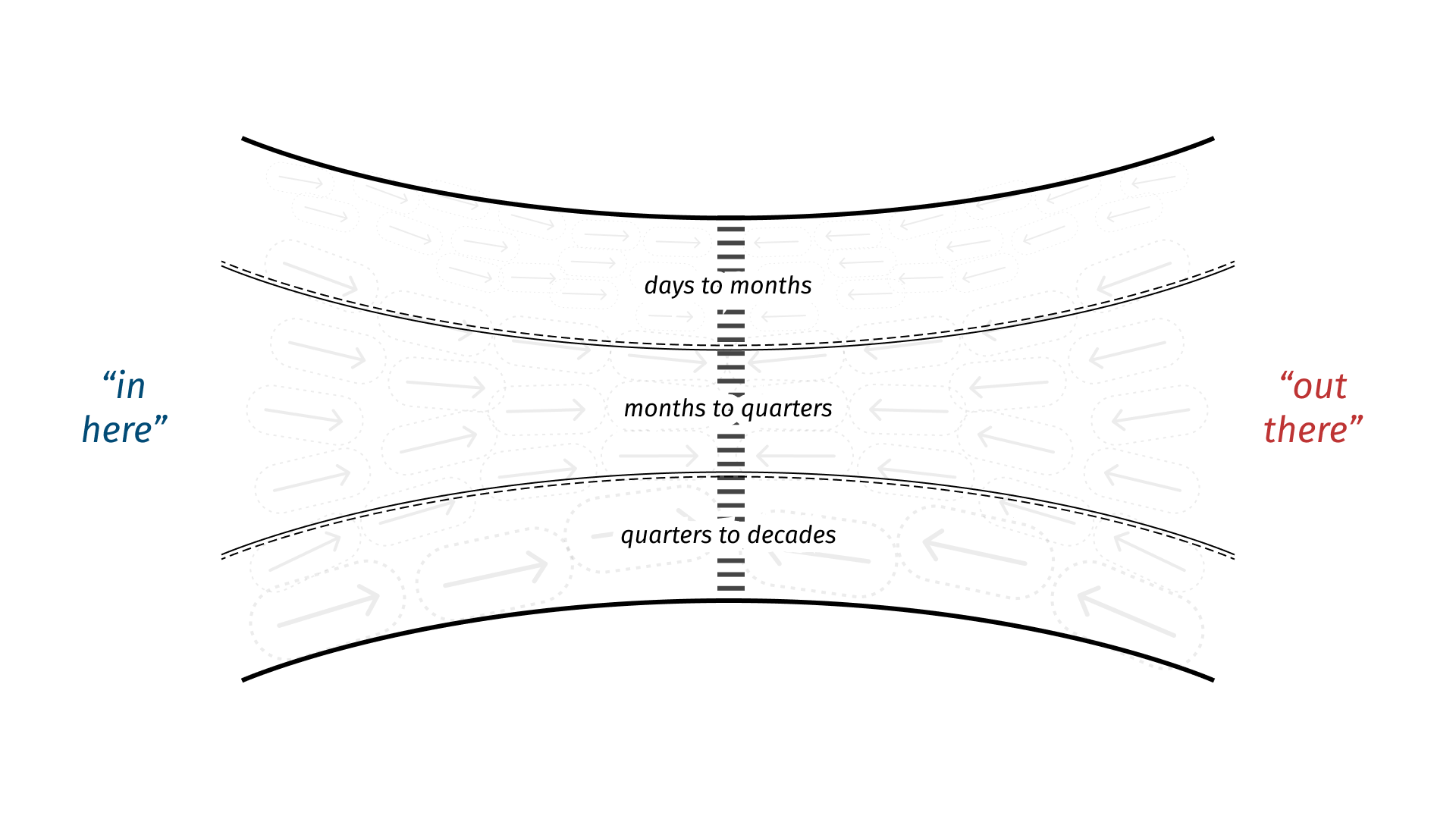
The relationships binding the original intent and aligning its play decayed. New games were created and new players were introduced to keep it all moving together. Their games targeted other games inside the organization, instead of the critical interaction between the external and internal activity. We call the players playing game-coordinating-games ‘managers’. We call the players who successfully coordinate and improve play, whatever their formal authority, 'leaders'.
As their scope and responsibility grew, the managers began to grapple with the task of timescale arbitrage. Amidst all the confusion of games interacting with games, the managers had to keep the faster-moving games healthy and productive, while also delivering setup play for the slower-moving games. The managers who were also leaders came to find that their play focused on protecting those fast-moving games from the influence, “strategic” ideas, and occasionally-unhinged perspectives originating in the slower timescales. The managers sealed into their own self-aggrandizing games came to find that their play could employ authority, misdirection, and disciplinary threat to serve the slower timescales at the expense of the players operating on faster cycles.
Some of the ongoing sub-games were well understood, and could be managed with detailed plans and top-down procedures. Other games, employing novel technologies and engaging with previously unknown audiences, were in uncertain territory; they could only be managed step-by-step, with each move revealing new information. Players suffered, and the larger game did too, whenever managers confused those different kinds of games, under-specifying what could have been analyzed in advance, and over-specifying what could not be determined until a move was made.
And somewhere around this time, you entered the picture as a player. Perhaps it was as a member of a team, a manager of a team, or a scope-based contributor like a consultant or a fractional advisor. Given your current vantage point, how much of that play do you see and understand? How much of that play is legible, well-considered, and effective? And how much of that play is perplexing, confusing, or even self-defeating?
The product organization is a well-developed kind of game with special terms and specific expectations for how play proceeds, even as many of its activities are novel, uncertain, and poorly-understood. The structures meant to organize players and orchestrate their direction — strategies, roadmaps, functional roles, organizational charts, methods, plans, investments, tools, and recurring meetings — guide that play, and also constrain, obscure, and harm play in unexpected ways. Expect this default condition in the growing and differentiating organization. Work will get stuck, teams will go astray, and other leaders will, as ever, pursue poor directions; they will also self-correct over time, so long as their illusions about the field of play are met with its reality.
Choose deliberately where it is worth your time and attention to intervene. Then find the grain beneath all those old layers of paint: see the games underway, evaluate the moves they are making right now, and understand their trajectory by following the sequence of play.
Other things of note
- My header image is a poor substitute for the notion of differentiation, which I discovered through Alexander's life-affirming architectural perspective in the Nature of Order, especially book two. If you have a moment (or six) to see it in action, I recommend the classic See a Salamander Grow from a Single Cell from National Geographic on youtube.
- My home gym in Porto, Cisma Jiu-jitsu, turned one year old this weekend. It's so nice to see the project set out its roots and really begin to grow. On-and-off, I've been training jiu-jitsu for almost as long as I've worked in research and product (still a brown belt, now with two stripes.) Reflection on that process is one major driver of the game-oriented thinking in this newsletter and my approach to consulting projects.
Until next time,
This is Dave's Monday newsletter for leaders in the product org: make good moves, help others play, reshape the game.


