


When I wrote about field sense at first, I said:
To have good field sense, you need to know the other players' games and their scope of awareness. This is a moving target, difficult to get a hold of, but to overlook it is doing a disservice to one's own team.
We can expand how we speak about field sense: in terms of its position, where you tend to look by default on the playing field, and its sensibility, what you look for within the games you and your teams are playing. This sensibility is a spectrum. It's possible, like some dragons in the executive suite, to play so strongly towards other players' interpretation of games and their scope of awareness as to lose sight of the field altogether.
Position and functional field sense
Training and day-to-day functional role create a default position for field sense. We can see it as below, in bubbles overlaid on the axes that define the playing field. I also include our summary sketch of the playing field, what's sitting behind that 2x2, for comparison.
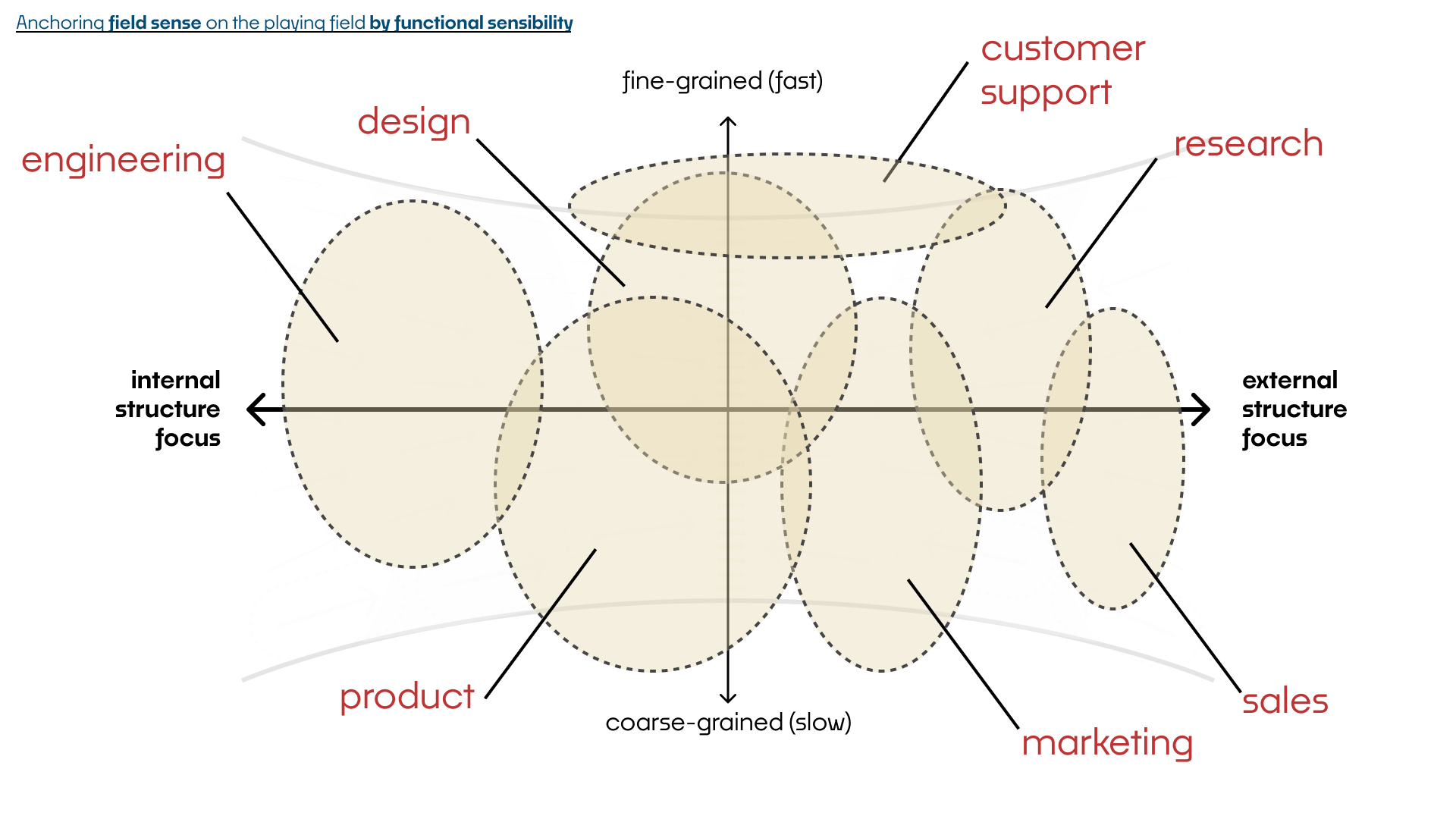
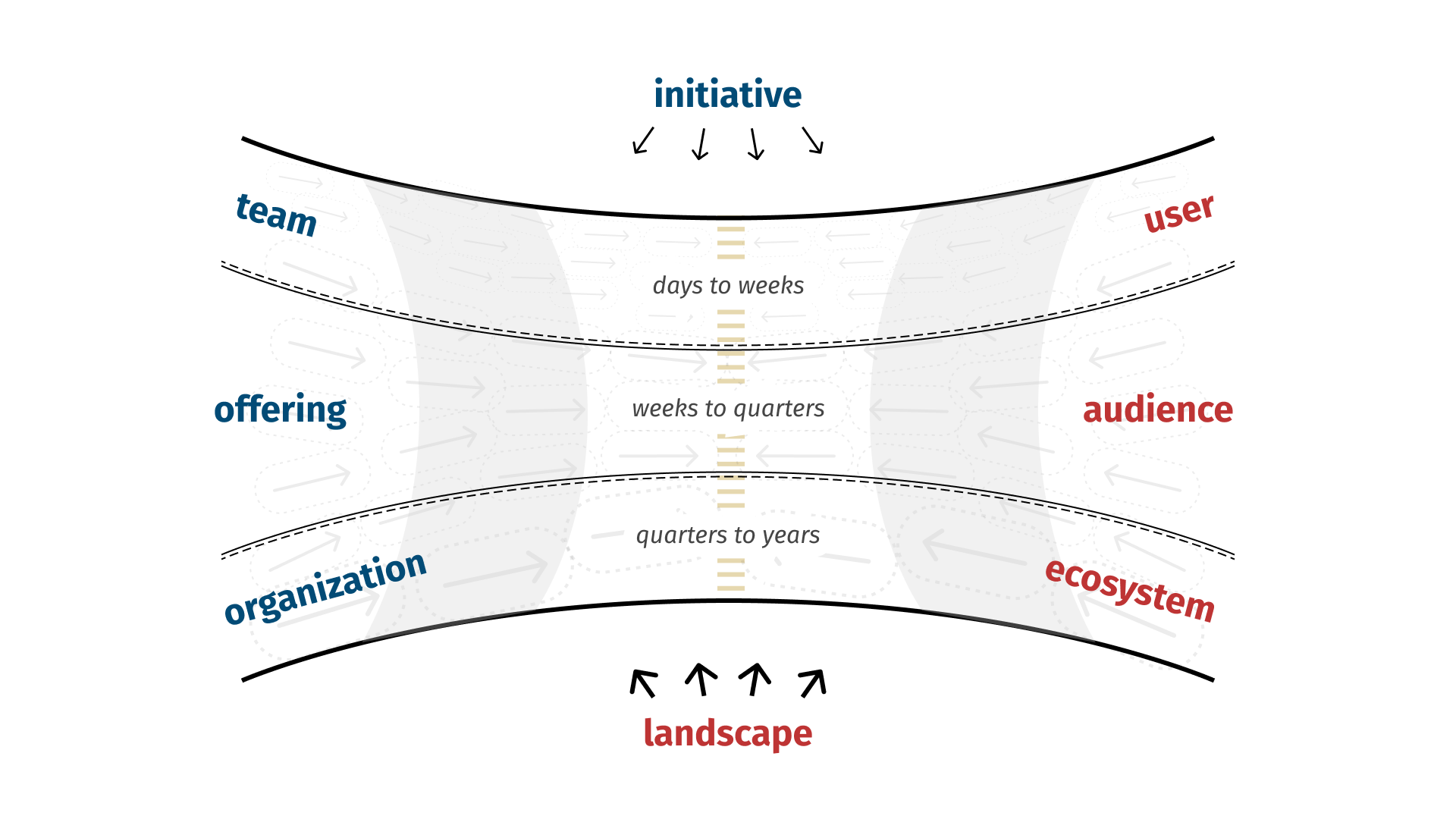
Functional field sense (image: bubbles on 2x2) overlaid to position on the playing field (image: 3 timescale bands)
Each bubble is merely a caricature of functional orientation, but a useful shorthand to speak about where people begin to look when they look at a game. Without a common language — or, say, space for sparring over visual models — some players remain entrenched and never learn to appreciate the importance of work in other positions. Possibilities for personal advancement and future play are limited if players let their existing position define what they will consider valid or interesting.
Growth is expanding the surface area of one's awareness and skill to operate across the playing field. New players' positional field sense may be focused toward the internal or the external, but that focus is primarily geared toward concrete elements on the playing field.
Sensibility for others' interpretation
As players grow into leaders, their field sense also evolves into a new kind of sensibility: understanding the scope of others awareness, and how they perceive the field of play.
We can draw it as a simple spectrum of focus — are you more interested in the structure that's available, or the perception of what's available in others' awareness? I show the two extremes of this spectrum below (honey bee and honey badger vs. chameleon and dragon), along with the wise and re-grounding influence that comes from a wider-spectrum view (an owl, though suggestions are welcome here.)
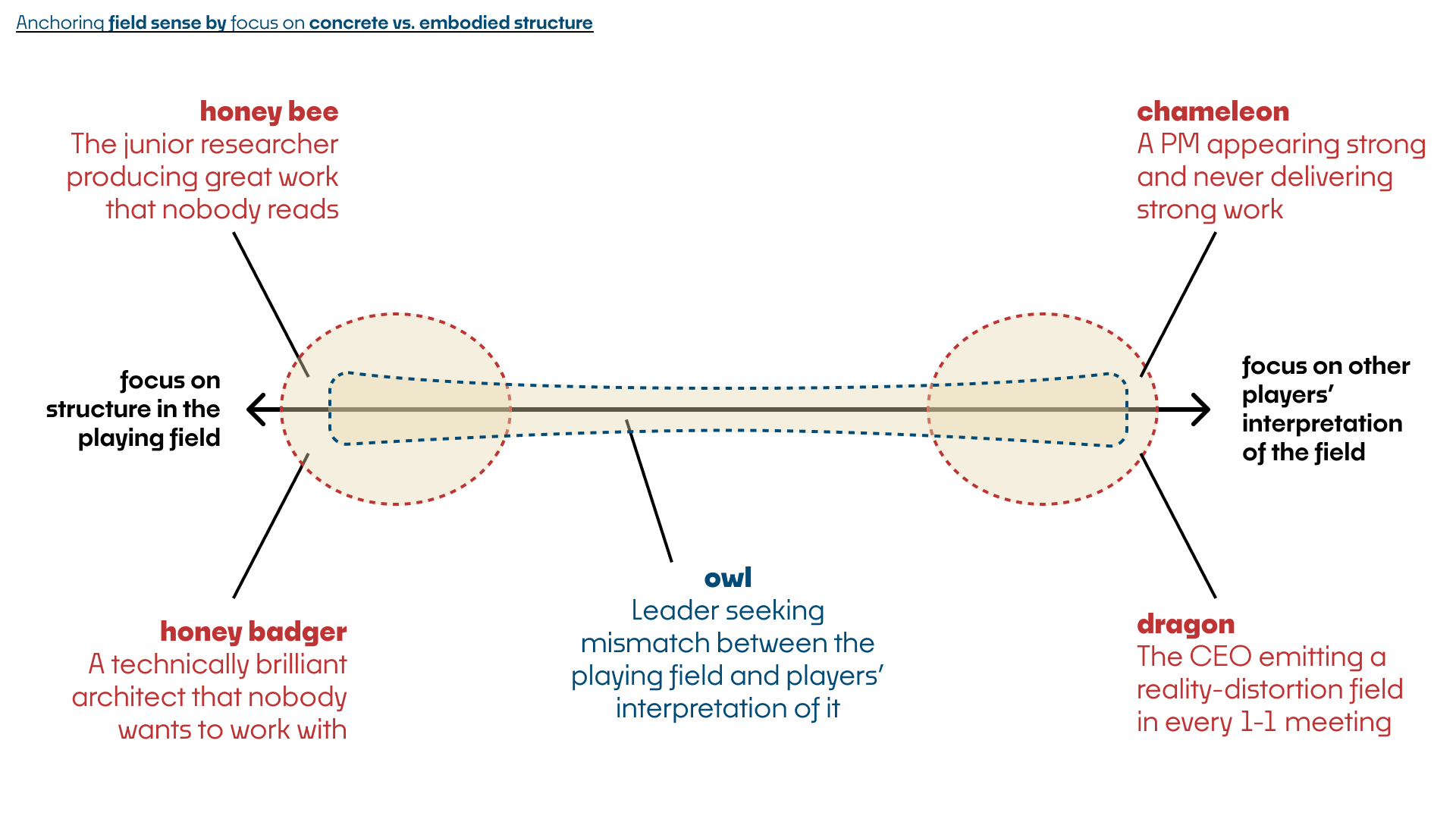
Players tend to grow from the left (concrete awareness) to the right (embodied awareness) over the course of their career. Some start strong on the right and if these chameleons are bestowed with organizational power and never learn to seek the structure of the playing field on the left, they become dragons, over time.
Left - concrete: Sensibility for the field is on the left side of our spectrum. Players who only focus on the structure of what's in the playing field can be technically correct and ineffective. I fell into this trap as an early-career researcher producing technically (read: academically) wonderful research without seeing what the people around me already knew, or didn't know.
Right - embodied: The sensibility that's critical for influence is on the right side of the spectrum. It's an awareness of what other players interpret, in terms of the game they're involved in and its field of play. Players who only focus on the right side of the spectrum can be highly influential and also ineffective or positively harmful.
Executives with strong reality distortion fields are the #1 cause of self-sealing narrative that leads to bad strategy and bad play. Even if you appreciate their power going into a meeting, it's hard to resist, not unlike the glamour of a dragon as Robin Hobb writes them. You'll leave the room and realize you've just confused their personal model of the game and the playing field — one you may take as entirely invalid — with reality. When you go back and speak with them to press your case, you'll find yourself in the same position at the end of the next meeting. If you're sharp, perhaps on the third try you will pin them down with on-the-fly disposable modeling. But it's better to avoid confronting the dragon directly, if you can.
Middle - the leader's path: A strong leader understands each side of the spectrum, without committing their full awareness to either. They maintain a working awareness of both ends in order to sense the inevitable oversights and illusions. A leader's field sense helps them find and address those situations before they evolve into structural decay or seal themselves into bad moves — timely and expensive propositions, if left unchecked.
A strong leader knows who to speak with if they don't have the full picture, or where to go next if they feel something is wrong but can't make sense of the situation. This is a difficult balancing act, increasingly so as you are responsible for a number of teams and a broad scope of product activity. Most of the keys to good gameplay reside in the tension between what's actually available on the field of play, what teams see, and what people believe is possible. We'll keep circling back around this theme.
For now, the question for any leader in the product org is: do you know a bad move if you see one? How?
Until next time,
This is Dave's Monday newsletter for leaders in the product org: make good moves, help others play, reshape the game.


