


You play the product game with other players. Sometimes it seems they are playing a different game than you. They probably are; if your scope of work overlaps, you need to a means bridging the gap.
Players who are new to the game see this situation and declare it a problem. Expecting cooperation without conflict, they diagnose: "Player X should not be doing Thing Y because it is stupid, or counterproductive, or a dead-end direction." They absolve themselves of further inquiry once they have diagnosed the situation. It’s near impossible to ask useful questions while holding firm to the idea that others are playing incorrectly.
Experienced players have a different view. They ask: "Given the state of the field right now — with Player X pursuing Thing Y — how do I advance the game in a productive direction?" These players inoculate themselves with the assumption that other players are playing perfectly*. Whatever others are doing, their play is not begrudged, it is accepted as the starting position. Experienced players cultivate a crucial skill for gameplay: creating the vehicle for necessary and difficult conversation.
Every other player on the field is a part of the grand game, even if they are playing a different sub-game than you are. What they see of the field, and, as a result, their own games, are elements of play just as critical to your game as any of the processes, products, infrastructure, and customers you work with.
Here is the importance of field sense: experienced players know they need to know how other players perceive the game, in order to understand their trajectory. They learn to figure out what other players see, so they can move the game forward, collectively. Constructive conversation and sparring — its more compressed form — serve a two-fold purpose: engaging with other players is the only way to see what they see, and this exploration of perspective begins to to bridge the divide.
Good Sparring is Good Play
The great joy in playing this game is finding room to play — to challenge, and push, and use our skill. The reward is not an end state. The reward is when players flex their full abilities, understand their own limitations anew, and move the game that everyone is playing to a new place.
“Arren’s fencing-master in Berila had been a man of about sixty, short and bald and cold. Arren had disliked him for years, though he knew him to be an extraordinary swordsman. But one day in practice he had caught his master off guard and nearly disarmed him, and he had never forgotten the incredulous, incongruous happiness that had suddenly gleamed in the master’s cold face, the hope, the joy – an equal, at last an equal! From that moment on, the fencing-master had trained him mercilessly, and whenever they fenced, that same relentless smile would be on the old man’s face, brightening as Arren pressed him harder. And it was on Sparrowhawk’s face now, the flash of steel in sunlight.”
— The Farthest Shore, p.178
Sometimes you are Arren, and sometimes you are the fencing master. In either case, you must enter into the game recognizing it as such: a game to be engaged in.
The tools for sparring are not swords. Sometimes it's stories, though they are dangerous to fight with. Experienced players separate the story and its implied view of the field from the player, so those can be explored and challenged without challenging the player’s standing or authority. They use disposable models and build organizational sand tables to create the conditions for productive sparring.
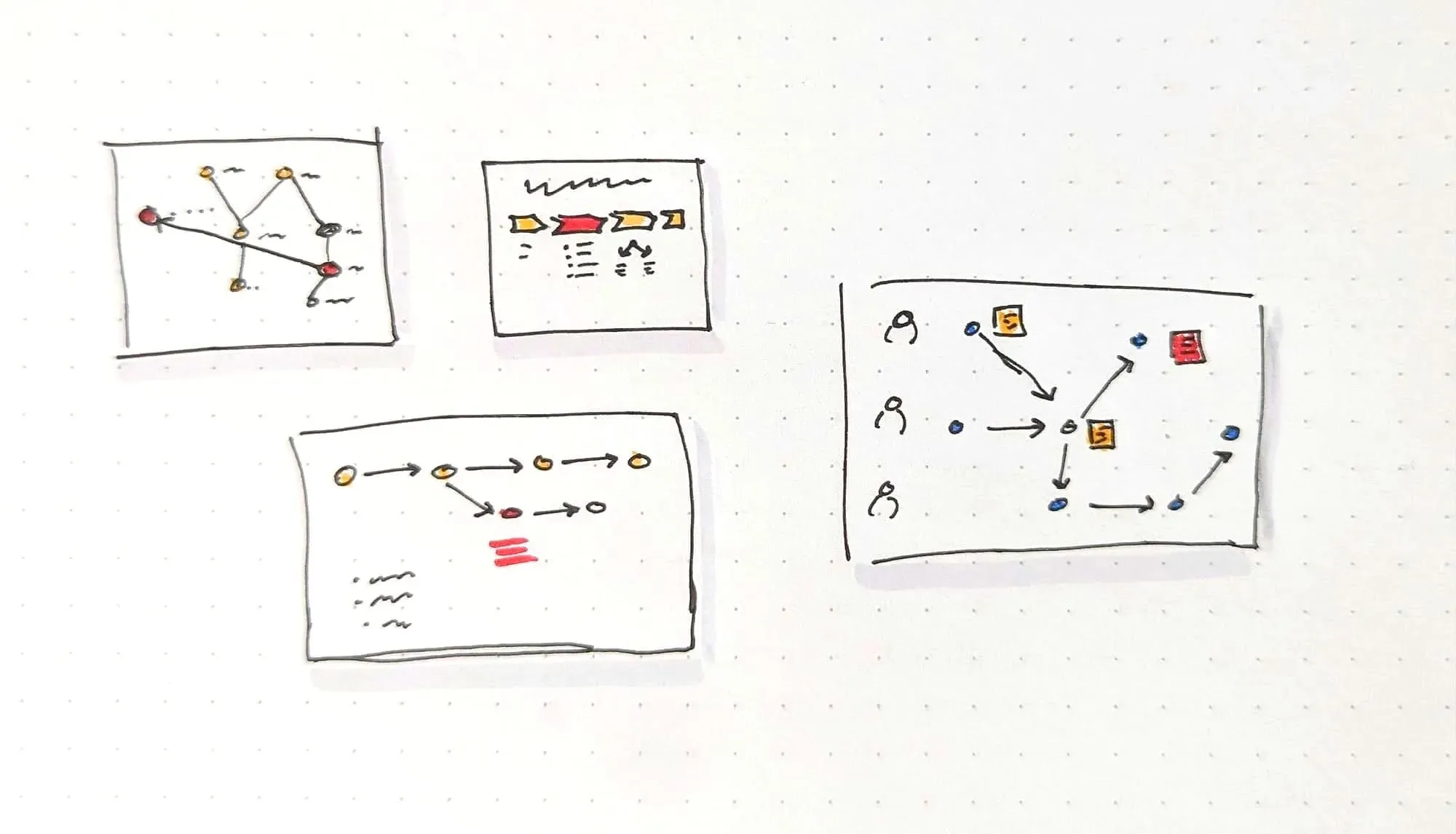
The trick is choosing the right tool, and loading it with enough of the other players’ initial view of the game so that they can and will engage in a constructive debate with all of their ability.
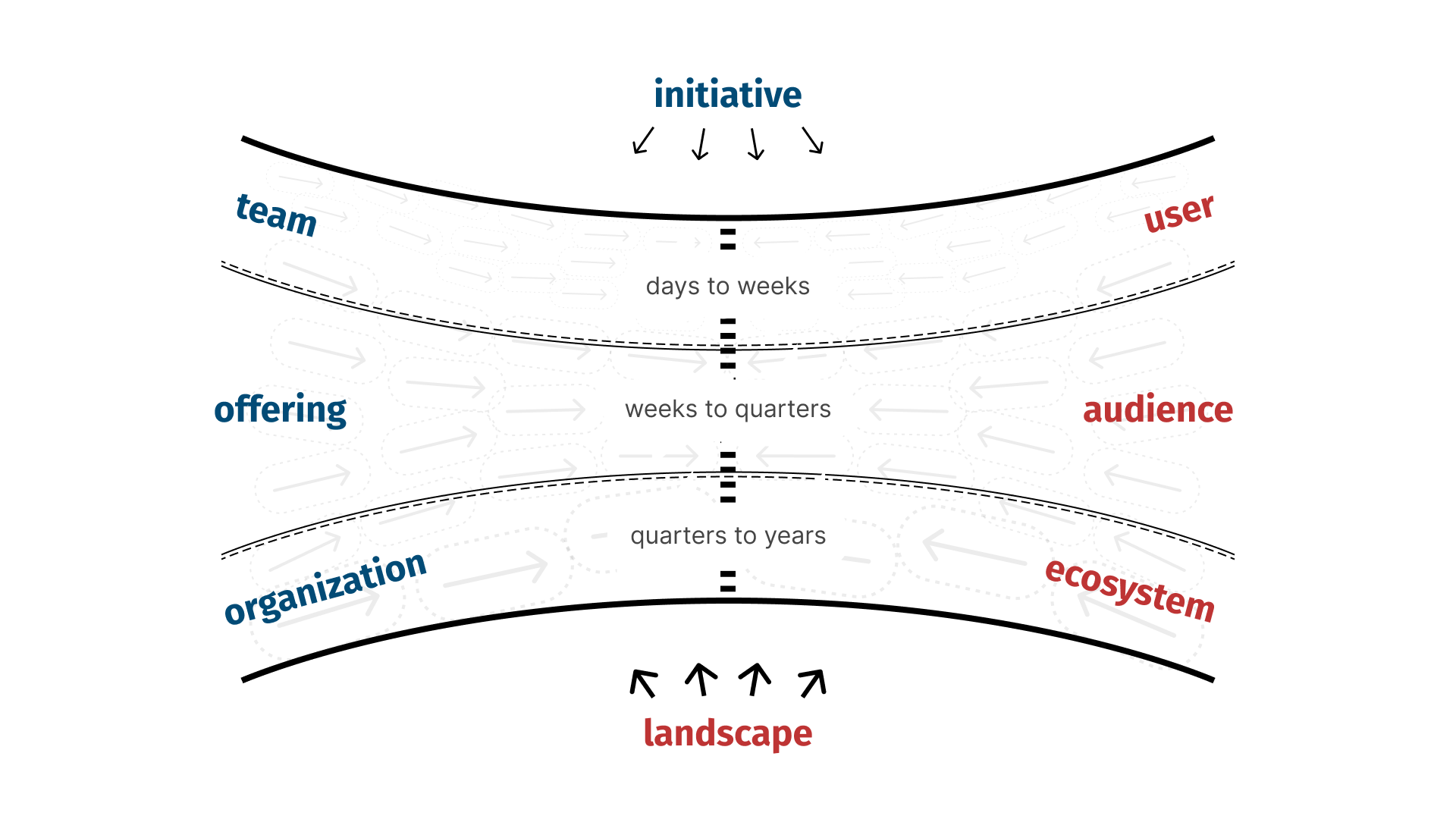
Depending on what’s at stake, where you are, and where others players are on the field, different tools will serve to move the game forward. We’ve explored this theme in User Models for Product Work, looking at useful models for different scopes of organizational activity (which are now timescales, in the product game context), and different parts of the field.
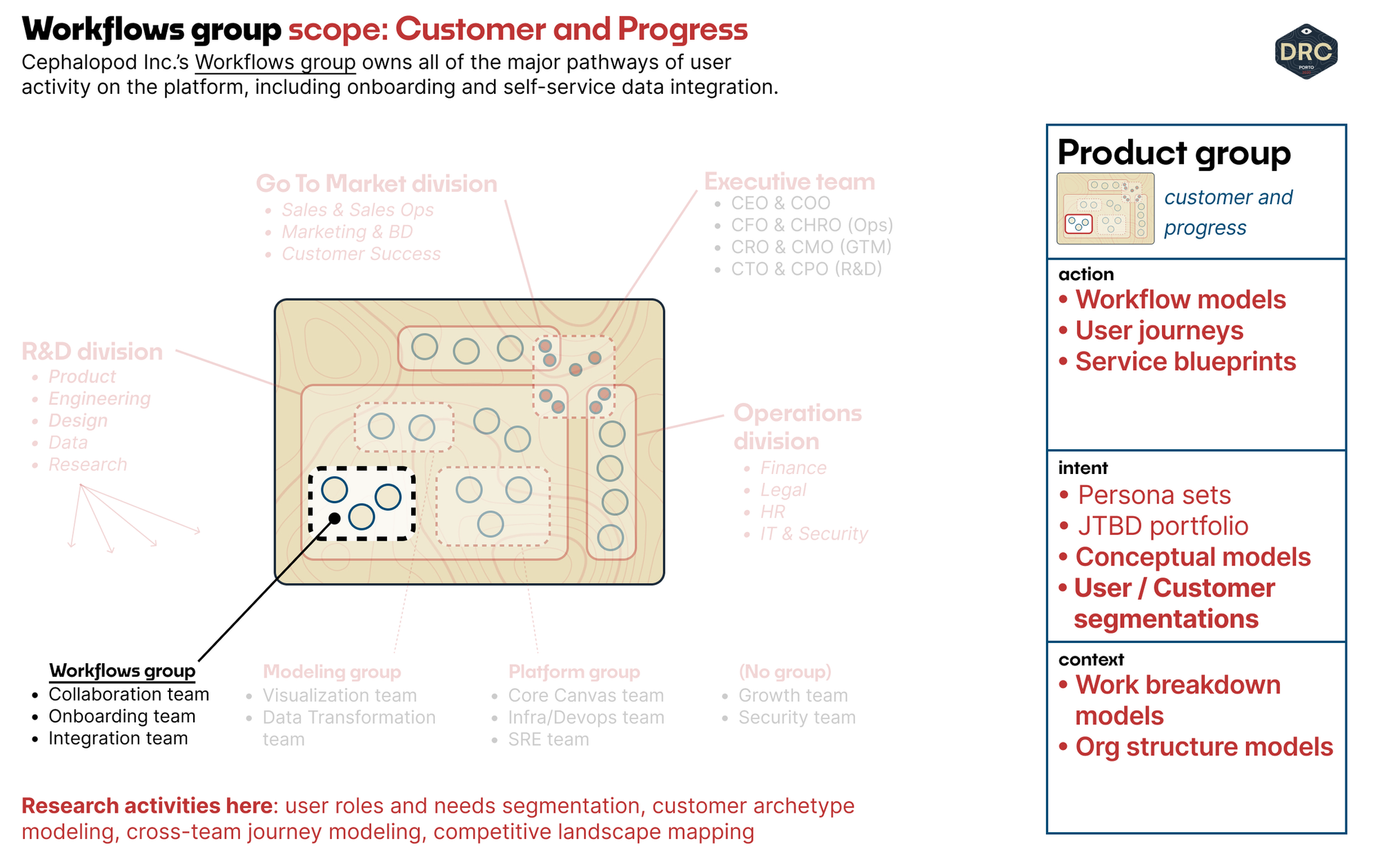
Almost all of the tools you may need already exist, but the contexts they will work in — whether or not they will be the right arena for productive sparring — depend on your position in the game.
The initiative at hand and the relevant landscape bound the game we're concerned with, and timescales plus type-of-concern point toward the right tools. Finding the right frame for sparring with others sharpens your awareness of the game, and it is the precursor to good sparring. It's difficult, at first, but there is a clear feedback mechanism: as you put little pieces on the board to try and model what's important, others' engagement is a signal of the success.
The sparring itself is not always a heavy push. It takes a lot of casual sparring to figure out what works and what doesn't, or to re-play prior moves and understand what went wrong. You will need to relentlessly press, from time-to-time, when the stakes are high and conversations are truly difficult. But just as often, you need room to play.
Learn how to create the right space for sparring. Cherish the trusted sparring partners: the good ones will explore known and novel situations with you, push back where they see weakness, and explain their understanding and rationale when they make the moves you did not see or expect.
Other things of note
- *In the future I’ll send a re-draft of The Perfect Response, updated to use our Product Game language, ‘playing’ on the field or ‘making moves’ in the game, instead of 'responding' to background structure.
- There's mixed metaphor here with sparring rings, models-instead-of-weapons, and fields of play. I'm not sure how it will reconcile, yet. I'm partial to 'sparring' even though it's 'practice' or 'training' in field sports. My experience with skill acquisition and play outside of a professional context is on the mats in jiu-jitsu. It offers a rich avenue of exploration in experience-with-situation vs. instruction-of-technique.
- I am slowly commercializing the wine I made in 2021 with a friend. The name is Rule Number One. It's a small lot: about ~1,050 bottles of red overall. Labeling logistics, because we've chosen to classify the wine as a Douro DOC wine, are a nightmare. Once the labels are in, we will to apply them to the bottles bottles, dip the top of each bottle in beeswax (we purchased 4kg, it looks like a large half-wheel of cheese), put the bottles into boxes of six, and sell them. We have a handshake agreement with a local distributor to buy the entire lot minus the personal stock to cellar, give to friends and family, and sample year after year.
Until next time—
This is The Product Game, a newsletter for players in the product organization.


