


In a prior edition I wrote about those maddening and logic-defying situations where:
It’s obvious that the work or the approach to doing it is misguided, untenable, or actively failing. But the team doesn’t seem to see it, nor are they acting on the situation.
The situation is doubly frustrating. At first, as above, because something is clearly not right and not working. Second, just as true (though it may not feel apparent at the moment), is that whoever is perpetrating the problem is smart. Most of the time, in most situations, the person or peoples who are causing this problem are entirely capable, and do a good job. Despite your current assessment of the situation, they are trying to do what they think is best, even now.
One Key Assumption
To get a handle on the problem, you need to make an important assumption.
In these situations, you must, at first, assume that the team, or whatever group[s] of people involved, are responding perfectly. “Perfectly” in the same way it can be said that the human body moves perfectly. That does not mean it responds as you think it should. A complex adaptive system, the body is essentially lazy, or more politely, energy efficient. It adapts itself to recurring patterns of action, compensates to avoid damage, and makes tradeoffs to remain internally coherent (e.g., prevent you from dying) for as long as possible.
The assumption that the team is responding perfectly is a two-fold stepping stone. First, it is an attempt to inoculate you against the incredulity and bias attached to however you are introduced to and experiencing the situation. Second, it forces you to recognize that there is something else at play. If the persons involved are responding perfectly, and there is so clearly a problem, it begs the crucial question. To what are they responding perfectly?
The body moves as it does because of its patterns of action, the environment it acts in, and the signals it receives and interprets to orchestrate its response. A perfect response does not appeal to any external ideal or master plan. A limp to protect the leg is a perfect response to a calf injury, just as a forward-leaning head posture is a perfect response to steady hours fixed and staring at a computer screen. Perfect responds to what is, at the moment; there is no better way, in light of current conditions, the locally available information, and prevailing patterns of action.
For the problem you’re working with, you must make the initial assumption that the people involved are responding perfectly, even if that response defies your current comprehension. You are not operating within the same time scales, with the same signals, or in the same modes of action as all the others involved in the situation. All of these elements — the people and the collectively interpreted situations they respond to — constitute a complex and continuous structure beneath and behind whatever symptoms of the problem you see and experience.
A Different Background
All of that structure that they are responding to is the background, as we use the term here. Somebody else in the "same" situation will not see the structure of things as you do. In fact, it's probably quite a limited view, as depicted last week.
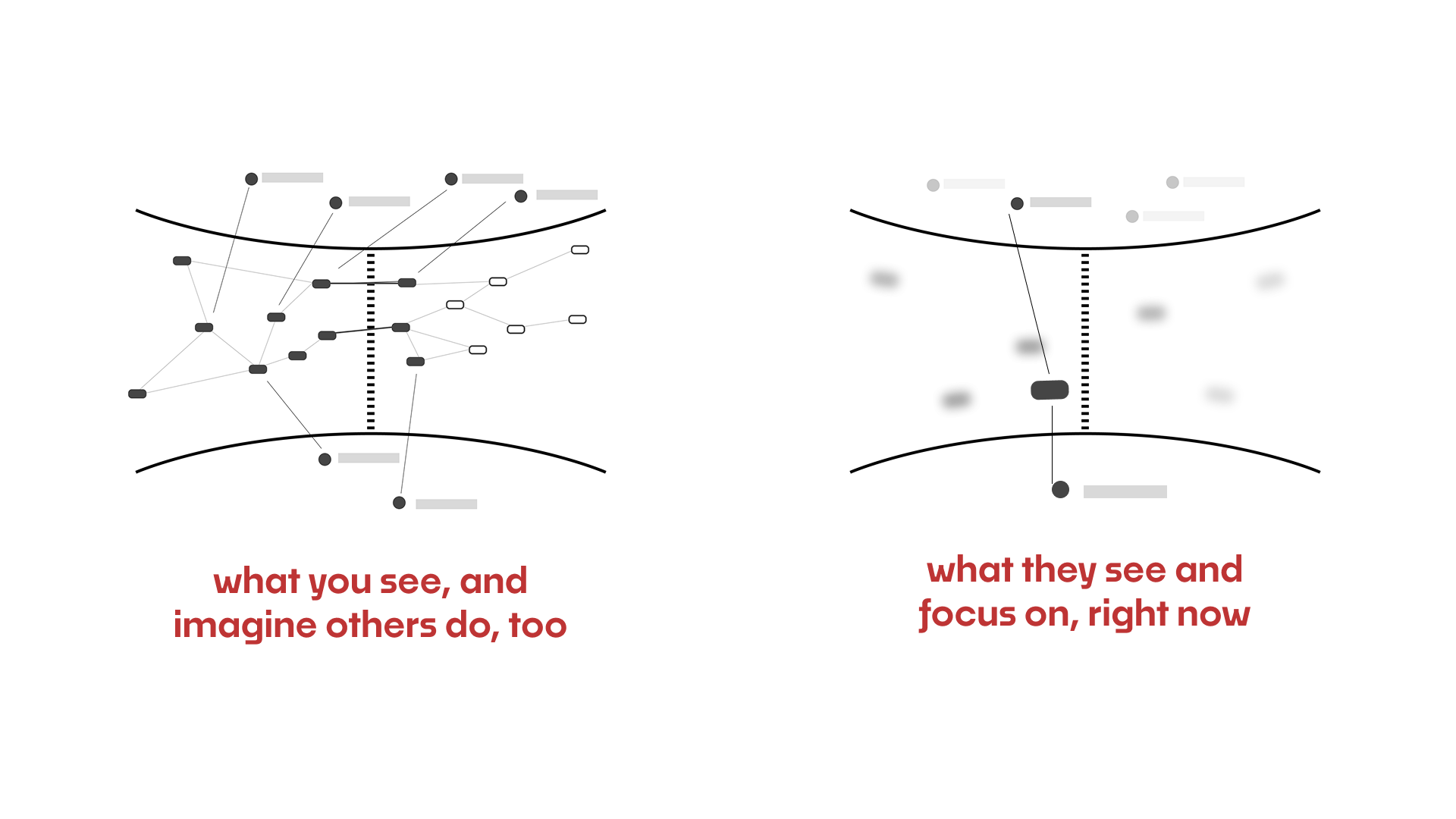
There is an extension to the assumption of a perfect response: if the team is responding perfectly to the background, right now, you can also assume team will continue to respond perfectly to the background in the future. You will not so easily change how they respond. It’s already perfect. But you can change what they respond to. In this regard, playing the background is a repeated testing of the hypothesis that the situation will improve if the structure behind it gets stronger.
And, despite how things feel, it is not all weak or broken, to begin with. Problems like these are felt because they emerge from the background of reasonably strong, healthy, and self-sustaining organizational structure. We'll dig into what the structure looks like, in updates to come. For the moment, see how your view of the situation changes if you can suspend your disbelief, even for a moment, and assume that the team is responding perfectly to its view of the background.
Other things of note
- Last week I read Callum Robinson's Ingrained (link to goodreads), a woodworker's coming-of-age story interleaved with a great step into the unknown for the business. The book is at times uneven, but it is more the roughness of a live-edged table than a fault. Attention to living material, the care required to shape it, and a search for the felt truth of quality work shine through the entire way. Short, sweet, recommended.
Until next time—
This is The Product Game, a newsletter for the leaders in the product organization. Whenever you try to adapt or improve the situation, you're playing the product game.


