


To speak about problems and players whose actions seem inscrutable, you need to take the wide angle view. To understand how to advance a game and make good moves, or why a very specific game is falling into common traps, you need the game-specific view.
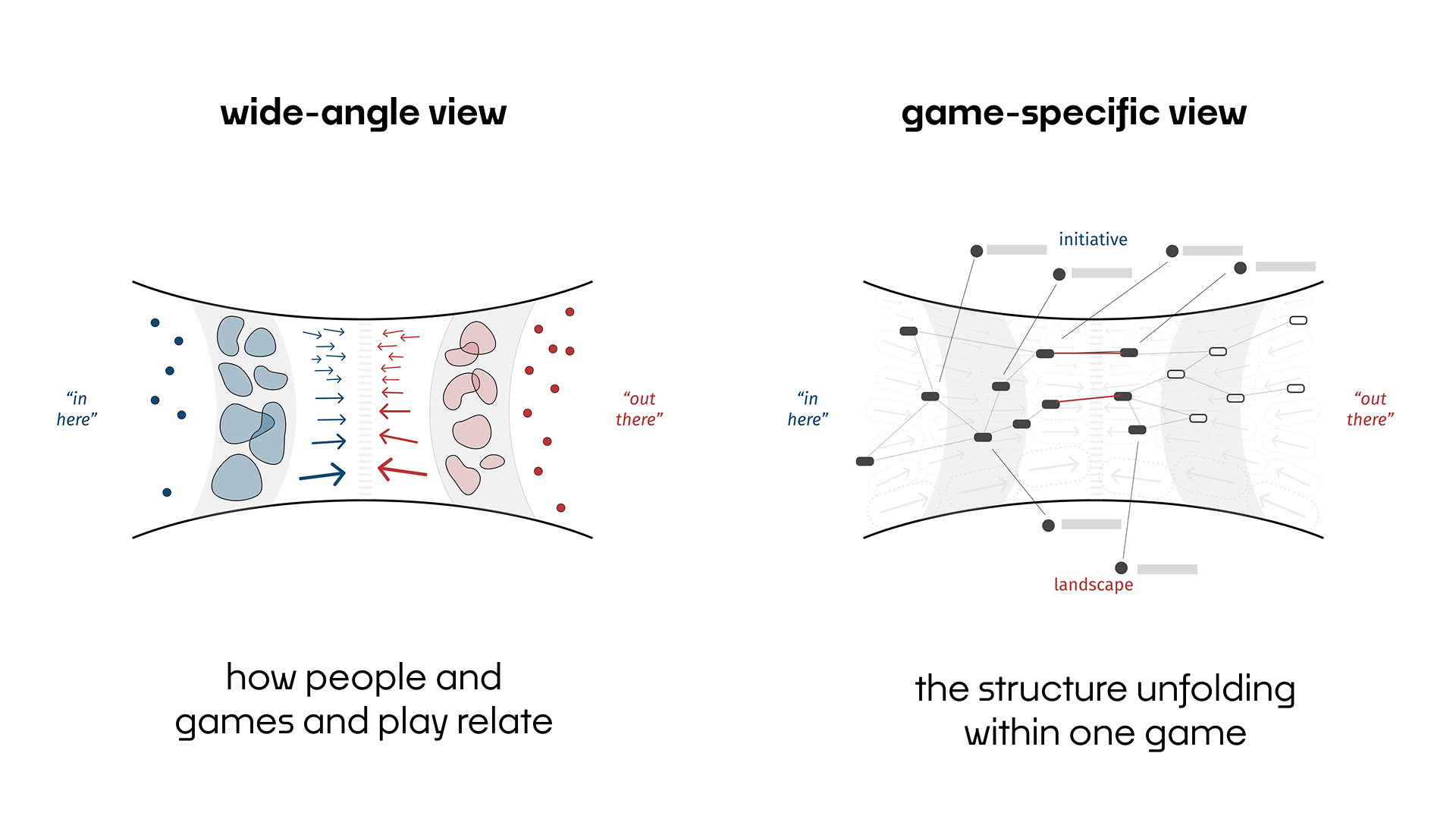
Both views look at the same field. The wide-angle view's perspective is zoomed out and the filter is tightened: it's only people, the games they're playing, and the moves that emerge. Each person is playing many games in the organization. The interaction of those games create the behavior you observe, and you will never see all of the games another person is engaged in.
The wide angle thesis: You can't change peoples' behavior directly, because their games determine how they play. And because those games determine how they play, adapting those games — how they are bounded, interpreting the field, and operating — will adapt how people behave.
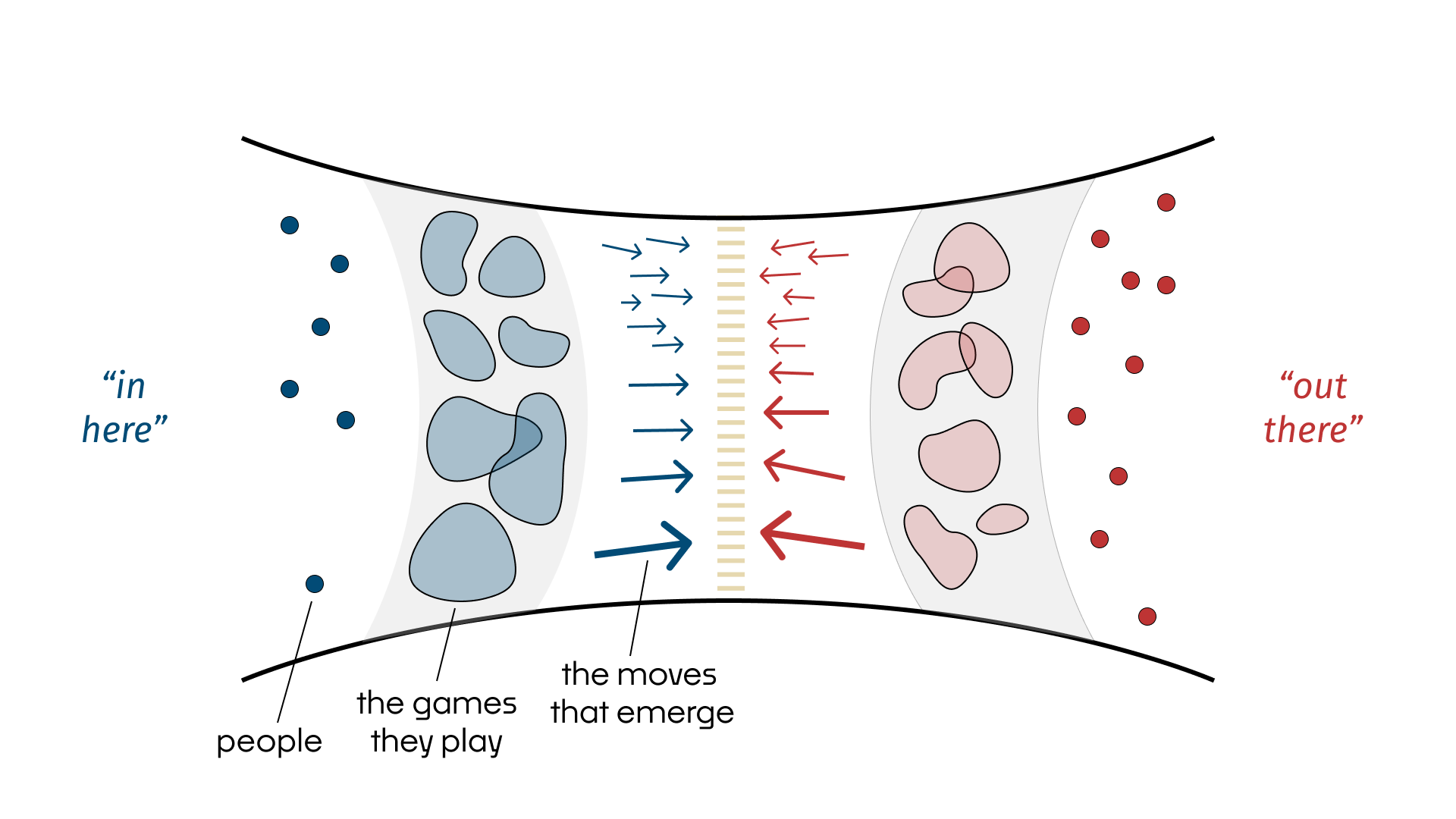
In the wide-angle view, you and the people you are working with are dots on the left. Users, constituents, partners, and customers are dots on the right. Everyone is playing games that relate and interact with other games.
From an organizational perspective, we focus on external games that cross the boundary of interaction. There is parity in dynamics on the inside and outside, though you work with those games differently and through more abstraction: distance and volume of activity outside are disproportionately larger than of that on the inside.
Players will come to know and work with tens or hundreds of people inside the organization over time. As a player, you join and create and adapt many games and their iterations within this context. The quality of that game is dependent on how well it sees the field and interprets that reality. In games that are highly dependent on external context, research is a mechanism for interpreting outside players and their games, each refresh of awareness with a shelf-life that corresponds to the timescale of the game that contains it. (The researcher's trap is to spend so much time interpreting games 'out there,' that they forget they are also an active player of the games 'in here.')
The wide-angle view gives context for a game inside the organization: every game only exists in terms of other games. Shifting down from the wide-angle to game-specific view, that context is collapsed primarily into the 'initiative' and 'landscape' zones of the field.
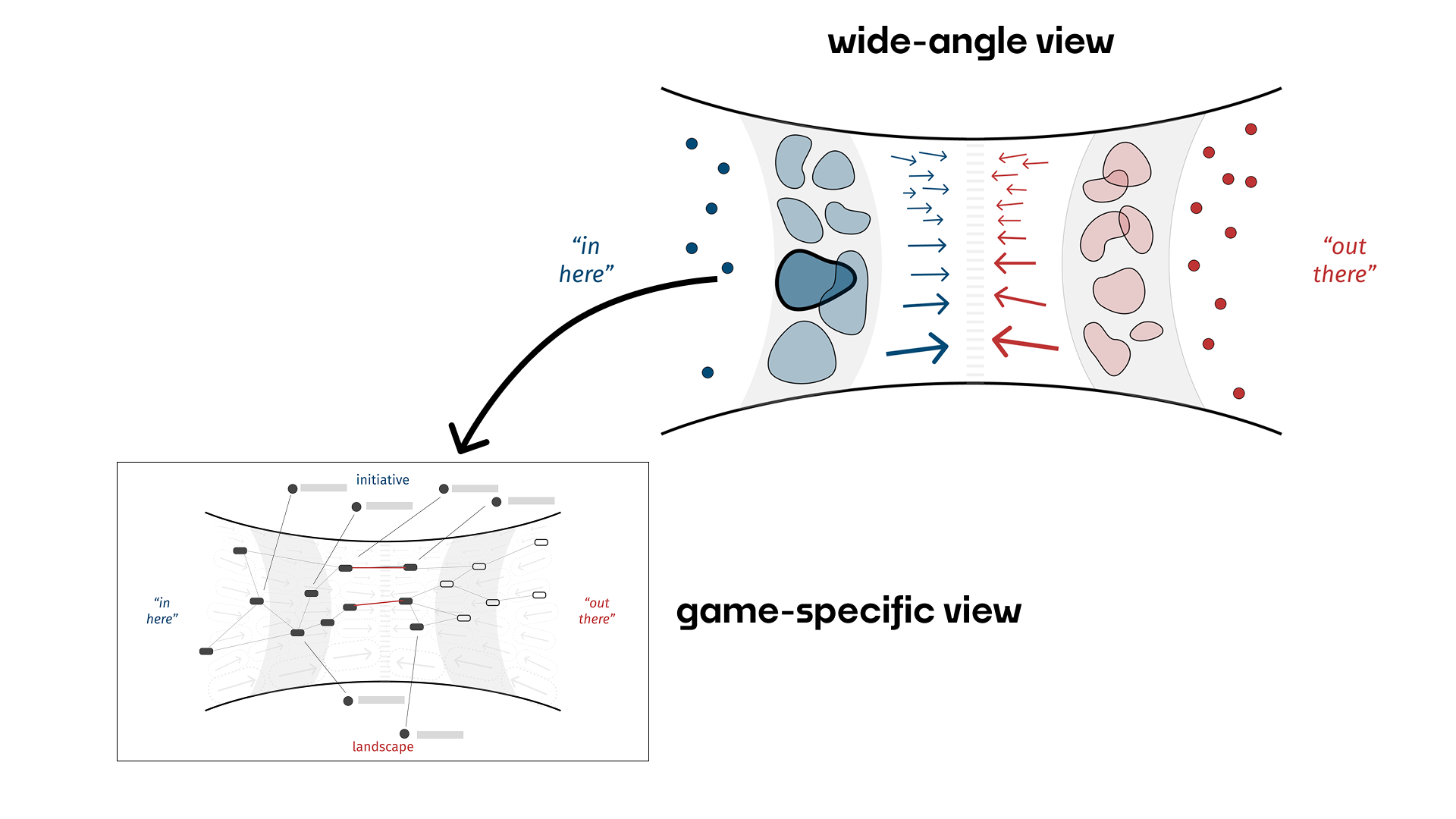
Both views are crucial. Skilled players keep two levels in mind for each game they engage with: a wide-angled awareness of context, and a fine-grained specificity for action.
Other things of note
- To fully frame quality of play, we will reincorporate a prior piece at the game-specific level: the sequence of play, drawing on Process vs. Sequence from 2024 and Sequence and Scale from 2025.
- On 'every game only exists in terms of other games', I draw on Alexander's framing of centers once again: as recursively defined, interlocking, and overlapping structures. It's time to revisit Carse soon, too, who reminds us that “Finite players play within boundaries; infinite players play with boundaries" in Finite and Infinite Games (goodreads link.)
- The July Grand Sumo tournament began on Sunday. The core events of Grand Sumo are its 15-day tournaments held every odd-numbered month. In June, an even one, there was a rare European exhibition in Paris, for two days. My brother and I went on Day 1, and saw Kotozakura win the day's single-elimination bracket. Some will try to tell you that football is the beautiful game, but have you seen sumo? Daily tournament highlights are on the NHK world site.
Until next time—
This is The Product Game, a newsletter for players in the product organization.


