


The more you work with different people and teams and organizations, the more you realize that there is a difficult and less-discussable layer of problems that lie behind the hard parts of the work.
Last time I sketched a bit of the self-fulfilling project. Now I think it's just the first of four hard problems that cause the going to get tough. Namely:
- The Self-sealing Narrative
- The Treadmill of Stagnation
- The Death-grip of Success and
- The Autoimmune Response
What was a self-fulfilling project last week is expanded to a more general archetype: self-sealing narrative. For lack of imagination I am calling them the four horsemen of product org problems. If you know the patterns it's just as clear that they arise in all arenas of life and work, personally and collectively.
The problem is when you don't see the pattern: you move forward as if rational discussion and direct intervention will solve the problem. The background structure behind the situation is viewed differently by each individual — seductive stories, as well the drive to conserve energy and retain power, dictate much more of what we see and how we act than we care to admit. To build collective understanding means to populate each individual's background with strong centers of shared attention, and that is work that is easily overlooked or considered "complete," rather than a place of continual maintenance and repair.
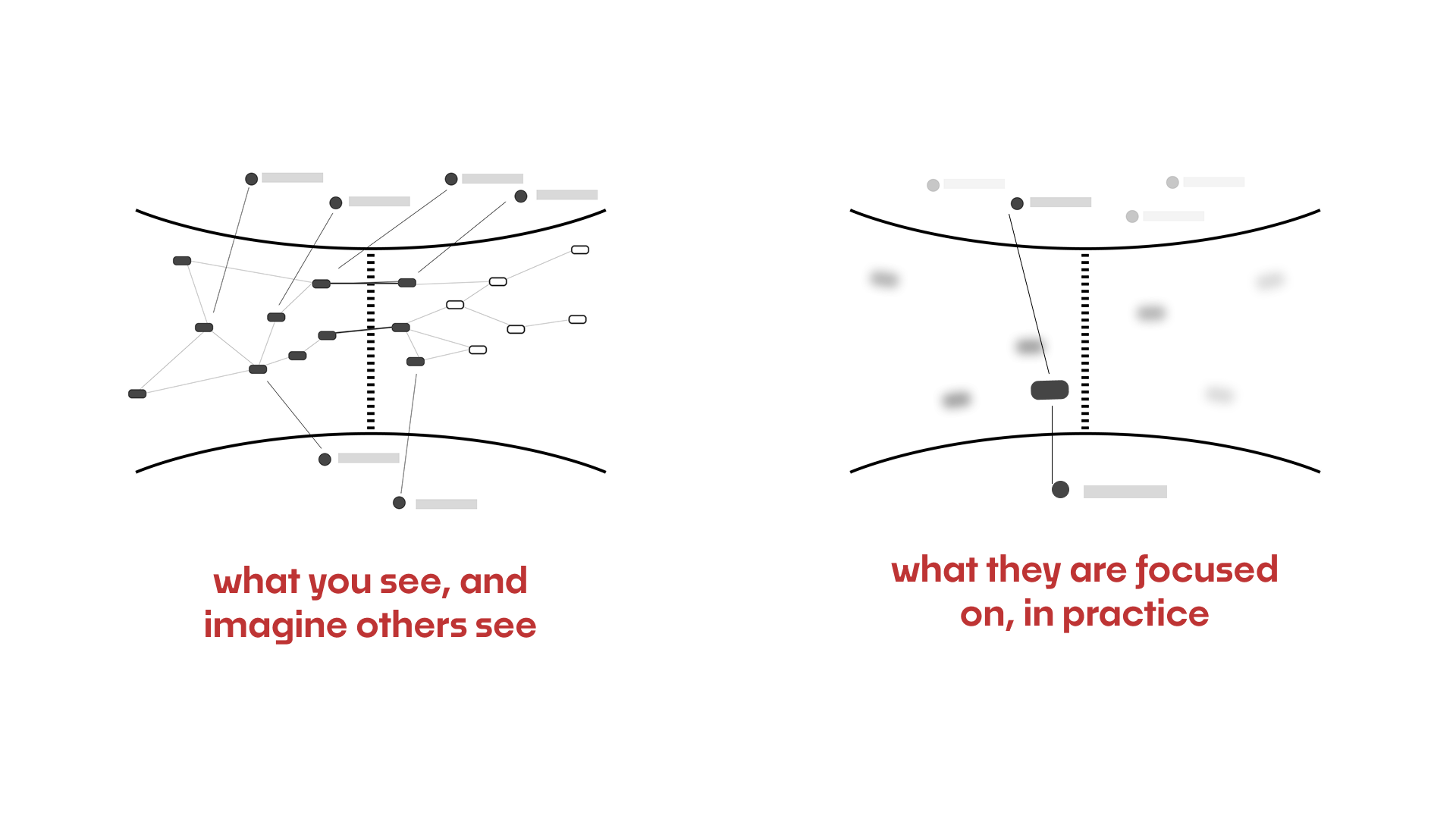
These problems are archetypes. They each represent a class of situations you have very likely encountered already. This week, a short of survey of the four:
Self-sealing Narrative
Stories are stories. Some are good, some true, some bad, and some dangerous. Any of these can become self-sealing when they wear the armor of their champion's authority, and can no longer be challenged on their own terms. Argyris describes the "self-sealing" phenomenon in Overcoming Organizational Defenses (link to Goodreads) of the undiscussable situation: the story is covering something up, or critically eliding certain facts, yet you cannot raise the issue openly, because pointing to the cover-up is not socially acceptable. And so each person who sees it helps in covering up the cover-up.
When two stories with two powerful champions come into conflict, the organization suffers collateral damage until one of them wins — and then it suffers more in the aftermath.
These narratives can be challenged from inside the language of the self-sealing bubble. Given the likely power dynamics at play, that's delicate and a bit tricky. (Discretion is key: a CEO I worked for would not talk to me for 6 months after I challenged a narrative that was apparently better left alone.) You can also work to repair the parts of the background that they sit adjacent to, removing some of their footing and their urgency. That's delicate and a bit tricky, too.
Treadmill of Stagnation
There is a difference between taking steps and making good moves. Teams and projects on the treadmill of stagnation are taking steps, and sometimes a lot of them, but never seem to deliver good moves. You have probably seen endless cycles of redesign, unfounded confidence in a failing feature, attachment to a beautiful (in theory) internal model that is not and was never workable.
In these situations, there is some self-sealing at play, but the dominant force is an attachment to an idea about how things could work or should work that limits the team from understanding how things actually work right now, which is the key to sidestepping the treadmill of stagnation.
To get off the treadmill, the team needs new options for traction, that are small, viable, and clearly connected to reality. Good research plays well here, so long as the researcher can start from inside the situation, and does not drop a research report and expect it to change hearts and minds.
Death-grip of Success
As conditions change and uncertainty increases, teams are just as likely to hold on to what already worked even more tightly, wringing it for all it's worth, while the very act prevents them from evaluating those conditions on their own terms and beginning to adapt. In this case, the problem is one of strategic direction: the team is traveling down a path that no longer serves the situation.
This death-grip represents the classic case of inertia as Simon Wardley describes it: like Blockbuster video offering online rentals first, and its addiction to the in-store late-fee model preventing it from seeing the opportunity. (See Climatic Pattern: Inertia kills in the linked chapter.)
To loosen the grip, you need to re-align the team on a larger view of the situation. And often that's re-building a collective anticipation of what happens next. Good strategic moves set up the next play, or can be said to open new opportunity, and teams with a death-grip on the past are not looking forward.
Autoimmune Response
The final of the four is a resistance to changing how the team travels: it's a problem of operations rather than direction. Teams will fight changes to how they operate, even when that change is lifesaving.
The larger environment we work in evolves, whether we do or not. Old ways of working grow stale, become brittle, and calcify. But those ways of working are tied to professional identity and sources of power within the organization. Plus, the energy cost of re-evaluating and adapting is far higher (at least, seen as such) than continuing to take actions with known and expected results.
To reduce the defensive response and shift how things work, a top-down overhaul is the worst possible option. (Past experience with such initiatives is why the defenses are so strong in the first place.) Rather, you find the weak spots in the existing sequence of operations, and use those as initial test vehicles for change. You have to find where the energy flows, so you can scaffold the change at scale.
Other things of note
- Names and nuance of the problems are still open and suggestions will be appreciated, as well as any stories you care to share that seem to fall under each type.
- I've re-read The Lord of the Rings over the last month. By "reading" I mean "listening" and Andy Serkis really did an excellent job as an audiobook narrator. Far better, from what I have heard, than he did at preserving the core of Animal Farm into its film adaptation.
Until next time—
This is The Product Game, a newsletter for the leaders in the product organization. Whenever you try to adapt or improve the situation, you're playing the product game.


