


You can have a reasonable product strategy that is effectively useless, without strategic traction. In Gameplay Before Strategy I said that it's "more important to make sure the team can play one good move, right now, rather than abstracting the reality of the situation for a far-flung vision of future glory."
One change: instead of a "good move," because good and best play are context dependent, the team needs to make a well-formed move — one that creates strategic traction.
In the last few weeks, we looked at four criteria that determine if the move is well-formed, and they are useful whether you use Shape Up, Continuous Discovery, agile or "agile" sprint cycles, or the classic waterfall. Here are those criteria, ordered by the likelihood that a product team is getting it wrong (an ungrounded move is the most likely mistake you'll encounter). A well-formed move is:
- Grounded — it targets concrete relationships; it carries a hypothesis.
- Constructive — it repairs weakness or creates strength; it's useful in isolation.
- Bounded — it's built from a sequence of steps; it has a clear endpoint.
- Enabling — it opens the field of play; it anticipates adjacent games and moves.
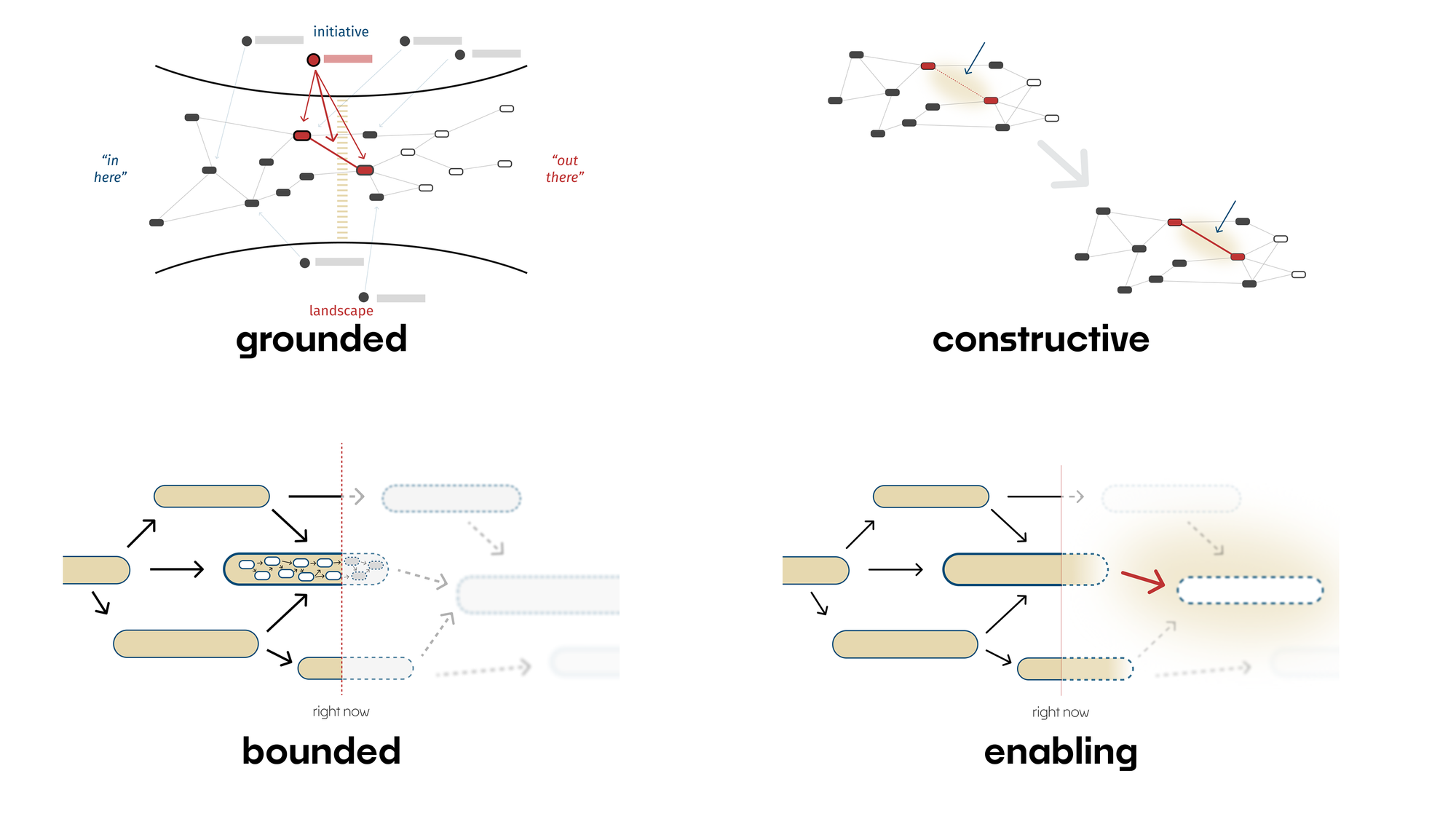
This is a simple diagnostic scan for whether or not a move is capable of generating traction through play. It will help you identify predictable pitfalls in current or upcoming work. You're not looking for perfection here, but the glaring weaknesses where early repair prevents downstream debt.
Engaging gameplay and strategy
In terms of the product game, traction is the clutch that engages the two-stroke engine of gameplay and strategy.
- Strategy is your theoretical view of a game: how you see conditions on the field of play, the most desirable destination, and the best direction of travel
- Gameplay is your practical approach: the content of the moves your team is making, how those moves are formed and funded, and the sequences they're played in
- Traction is how the game reveals itself when you act on it: it's the feedback from gameplay that informs and reshapes strategy, and the fit between strategy and field conditions that drives good gameplay
Traction only emerges in the course of play, when the team is making well-formed moves. Traction is evidence that certain directions are easier, stronger, or more coherent. It reveals previously unseen constraints and opportunities, and shows the path to act on them. As you repair weak gameplay, you will start to see it:
- the team clearly articulates why certain moves are good or bad
- organizational appetite increases as work progresses
- work becomes legible within and across the organization
- adjacent teams coordinate around complementary moves
- abstract enthusiasm becomes pointed and actionable moves
- customers pull in your direction of travel, they aren't pushed
- previously unseen paths to desirable destinations emerge
Lack of traction creates strategic debt
Poorly-formed moves create strategic debt — lost quarters of work, vestigial structure that requires further investment or rollback, and a weakening of audience trust. Worse yet, the signal the team receives from leadership is that the appearance of aligning with corporate strategy is more important than delivering well-formed work.
You know you're taking on strategic debt when:
- teams can't say what the work is targeting or testing
- alignment meetings and syncs and checkpoints increase but progress does not
- scope and criteria for success continue to fluctuate
- quarters pass without materially changing the field of play
- it feels more important to protect the plan than to respond to evidence
Beware. That debt is not just the team's fault. They are responding perfectly. I worked with one team that actively avoided interpreting customer feedback, because they saw it at odds with a strategy that they were required to enact. The two-stroke engine of strategy and gameplay became disengaged.
Initially poor gameplay caused leadership to double-down on their reasonable-sounding (but unproven) strategy, which further reduced the team's ability to form good moves or respond to their understanding of the field of play. Product reviews, instead of places for learning and adaptation, were checkpoints for leadership to make sure the team was holding the course. At some point the team had stopped responding to the field altogether, simply choosing moves with strategic optics.
Traction is a strategic priority
The two-stroke engine of gameplay and strategy requires traction to kick into gear. Where the team generates traction is where strategic possibility emerges. The only way to get there is to improve the moves you're making right now. You need basic gameplay in place before any overarching strategy will take hold.
If it is not well-formed, the leader's first concern is to improve their product teams' gameplay. Coach them into moves they can learn from, so they understand where they are and how to navigate the field of play. You don't need to micro-manage every step they take towards a move. You do need to ensure the moves they are targeting are formed well. Be prepared to respond to what they see, once they are seeing clearly.
Other things of note
Dave's Research Company issued its first invoice in September 2020. This September, the company is six years old. Better yet, your faithful correspondent will have received the illustrious Employee of the Month award 72 times in a row!
Ever mindful of hard work, the boss gave me a holiday week on Pass'Aran, a hut-to-hut trek in the Pyrenees. I tried hiking poles for the first time. When I learned the proper technique for uphill climbs — straps receive downward pressure from the heel of the hand, a similar feeling to pressing yourself up a ledge — I quickly converted to the pro-pole camp.

Until next time,
This is Dave's Monday newsletter for leaders in the product org: make good moves, help others play, reshape the game.


