


If you are a wayward hiker and take a dead-end fork, at some point, you'll recognize you've made a mistake. You'll try to figure out where you are, where you went wrong, and assuming a clean trail in the reverse direction, you retrace your steps and then carry forward. You may be frustrated at the lost hours or extra miles.
If you are a wayward product team and take a dead-end fork, at some point, you'll feel you're heading towards a dead end, then spend a few hours reiterating why this is an important path to be on. You'll camp for the night; cold, but resolute in advancing. In the morning, you'll start squeezing through brush and hacking at brambles. Weeks in, not much farther ahead, you celebrate progress by virtue of all that hard work. Then, at the end of the quarter, you'll quietly head back to where you took the wrong path, and choose the right direction. Afterwards, no one will publicly discuss what happened.
Good Moves
Product strategy is expressed in the moves your team makes on the field of play. Or as above, the path you take at each fork, one after the other. Bad moves waste work, overcommit resources, and close future possibility, to say nothing of the toll they take on team members stuck out in the wild.
As you look at the work you're shipping right now, or planning to play, it ought to have four qualities:
- Bounded — it's built from a sequence of steps; it has a clear endpoint.
- Grounded — it targets concrete relationships; it carries a hypothesis.
- (Last week:) Constructive — it repairs weakness or creates strength; it's useful in isolation from other games and moves.
- (And this week,) Enabling — it opens the field of play; it anticipates adjacent games and their moves.
Anticipate What Happens Next
A move is enabling when it sets up another one. You look ahead to see whether or not that move connects to new or better possibility. Last week I argued that each move must be valuable on its own, worthwhile even if you couldn't make a follow-up. Delivering non-value on the promise of follow-up work is not good play.
But you will make another move, and you'll have to work from wherever the last move took you to. Others in the organization will play off of that move as well, just as you play off of theirs. Strategy emerges from gameplay so long as that gameplay is not a random walk. Each move should put you in a better place than you were before, given the direction you're trying to travel.
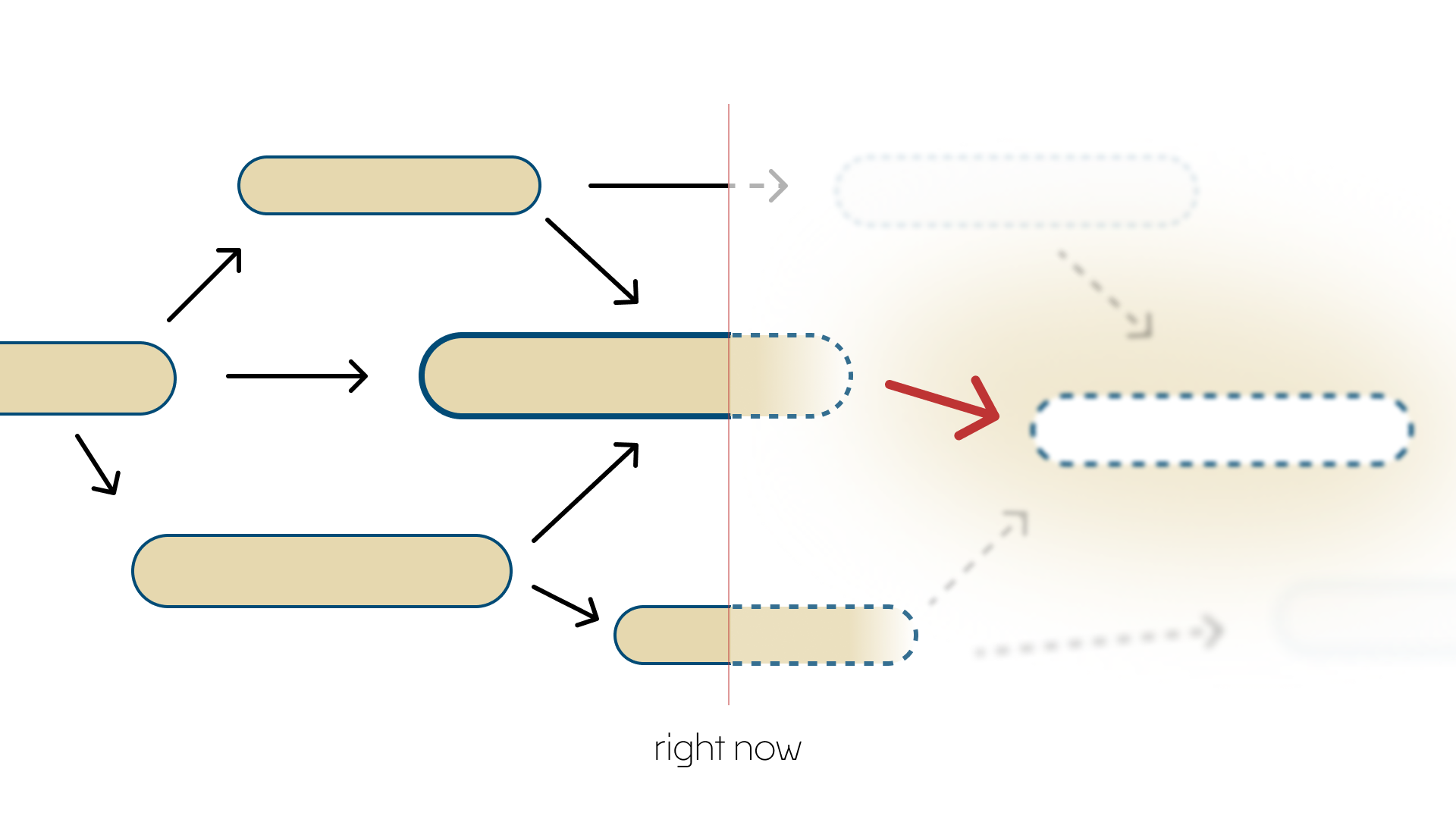
Moves that are not enabling take you to dead-ends and create product debt that you'll struggle to support and maintain. They emerge from self-sealing bubbles of excitement, from power dynamics, and simple lack of situational awareness. Without a wider view or directional hypothesis, they undermine your ability to move in the right direction.
Cheap Wins and Low-Hanging Fruit
We chase moves that are not enabling because they sound like a great idea in the moment and in isolation.
Sales hears extreme demand for a specific feature from one named account and it sounds like a great win to a struggling product leader. (Only the sales person goes to President's Club once it's built and sold.) The CEO hears about an industry trend that connects to a board member's personal priority: suddenly there's a new initiative pasted onto a product strategy pillar. Most seductively, the product team hears enough of a customer request that they begin to solve for a symptom, without seeing the problem, and they end up entrenching the workaround into their product, instead of solving the deeper problem.
These are exciting situations that offer immediate traction, but they rarely include rationale for what comes next. They create new surface and structure: things that cost time and energy to build, that customers will become attached to, and that other teams will build on and maintain. For a quick hit of success, you weaken the overall structure of the product with something that will cost much more than it earns.
Diagnose and repair
To avoid building into dead ends, anticipate what comes next. That can begin by examining work with a simple diagnostic:
"Once we've built this — what does it let us do next that we couldn't do before?"
Without a clear answer the team is on the wrong path, or they don't understand how to weave their work into the larger field of play. Given organizational pressure and individual incentives, it's not easy to turn the team off the wrong path, even if you show them where they're heading.
There's still potential danger, even when the team identifies an important next move, if the current path doesn't actually connect. Consider another line:
"Why can't we just make that move immediately, instead of doing this first?"
Scale your effort with the amount of time they'll spend out in the woods. Sometimes they have to learn for themselves — but don't throw quarters of gameplay and product investment down the drain for a lesson.
Other things of note
Last week I recommended Robin Hobb's Realm of the Elderlings to a friend. If you're not put off by eventual dragons and a humane bit of magic, I recommend it to you, too. (It starts with Assassin's Apprentice.) Here's a thought from one character regarding another, in Fool's Fate:
[He] was in his element, organizing and improvising. He burned with a fierce joy at putting his thoughts into action. I realized then that in his own way, he would have been a fine soldier and strategist, much as Verity had been. The times in my life when he had seemed most alive had been when he had finally flung aside all constraints to transform his thoughts into deeds.
It's easy to judge a player by their performance. It takes more effort to consider what game they're responding to, and then, how you can change it so that players can act productively.
Until next time,
This is Dave's Monday newsletter for leaders in the product org: make good moves, play well with others, change how the game is played.


