


A considerable lot of bad product work is perpetrated in the name of grand strategy and executive strategic priority. Top-down strategic planning gets the order wrong: good strategy emerges from the practice of good play.
Every good move made in the product game creates strategic possibility, but a great plan does not guarantee good moves. So we focus on gameplay before strategy: when you reliably play one good move and then another, you have a real foothold for strategy.
I use four first-pass criteria to look at work in flight. A good move is:
- Bounded: composed of a set of steps; has a clear endpoint.
- Grounded (last week): targets concrete relationships; carries a hypothesis.
- Constructive (this week): repairs weakness or creates strength; worthwhile in isolation from other games and moves.
- Enabling: improves the wider field of play; anticipates adjacent games and opens possibility.
Add Strength to Existing Structure
A move is constructive when it strengthens existing structure — especially the coupling between internal activities and external activities.
I argued last week that a good move, when it is grounded, targets relationships on the field of play. When the move is constructive, it improves that relationship. The improvement may focus on the internal side, the external side, or the connection between them by (1) repairing existing weakness, (2) amplifying existing strength, or, if the relationship is latent, (3) introducing new structure.
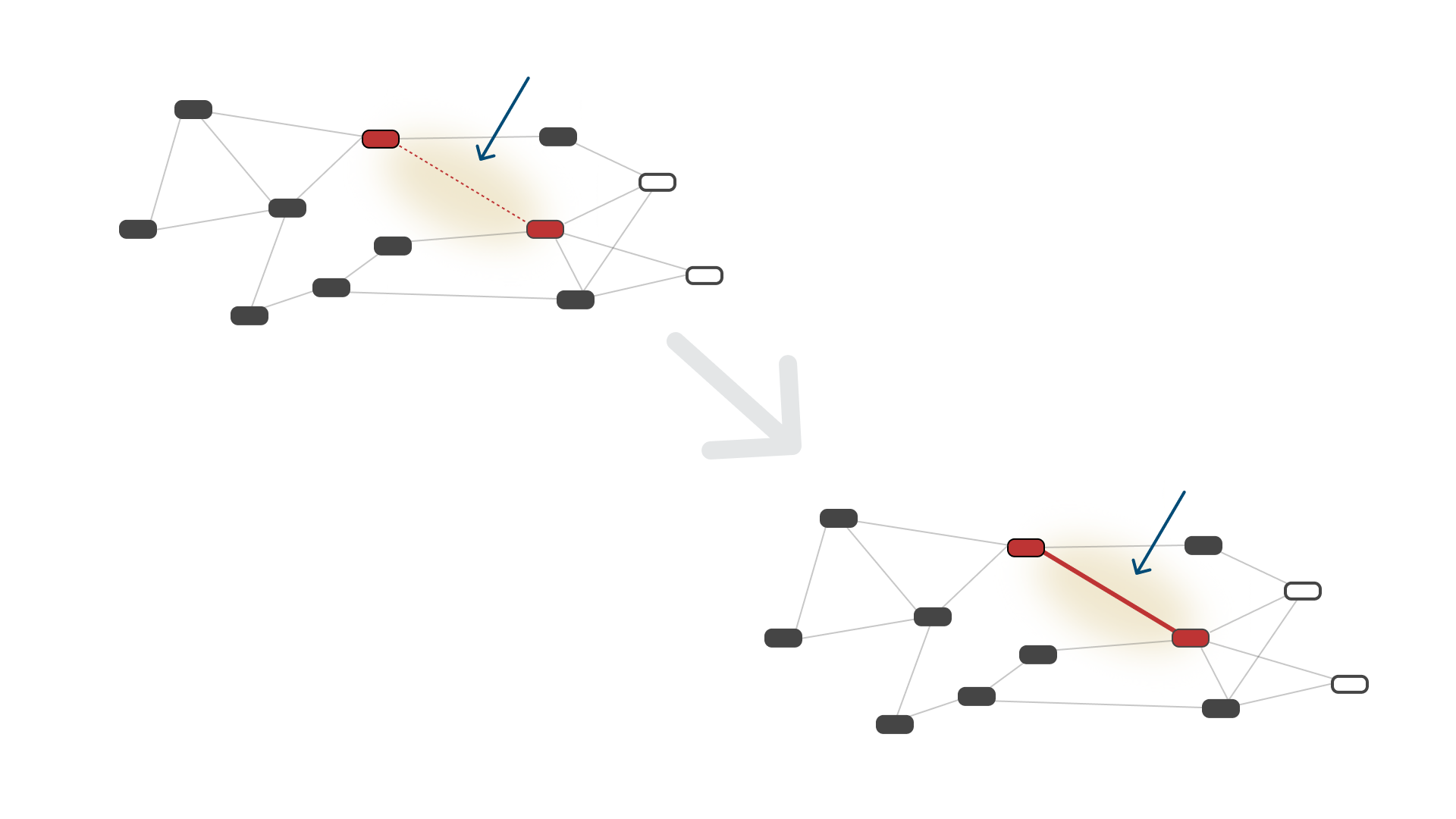
A constructive move is worthwhile on its own. That is, in isolation from any other consideration — other games, follow-up moves, long term approach — it makes sense in the current field of play. It adds strength or improves something.
Almost paradoxically, specific and constructive play is where strategic traction emerges. A constructive move makes good sense in isolation. In sequence, one after another, it is constructive moves that change the conditions of the field and allow for new strategic possibility to emerge.
Moves that are not constructive do the opposite. If you make moves that depend upon hypothetical future play to become valuable, you accumulate strategic debt and close down future possibility. You either end up with wasted work, or commit to an unproven follow-up before the setup is even out the door.
'V2' and 'Beta' Obscure Bad Moves
Other organizational games and high-powered players' pressure overlap and conspire to preserve momentum for a bad move. The larger the organization, the easier it feels for a team to continue on planned course than to reflect and redirect.
When the team senses that their move is not constructive, but can't acknowledge it to themselves or leadership, they soften their stance with a beta tag or a required follow-up phase: "We just need to get out the MVP," or, "we obviously need to launch this so we can build V2, which is what customers want." Self-sealing mental gymnastics obscure the disconnect between the inadequate current move and desired future state.
The problem is that V2 or the end of the beta period, however the team imagines it, is hypothetical. It takes a few years launching product work to realize a next version that promises to correct current problem is more fantasy or bargaining tool than reality. Unless the move was planned as a beta from the beginning — with clear conditions for participation, learning, and closure — you're going to have a mess on your hands.
Diagnose and repair
Don't justify a bad move with an imagined future result. You know how product organizations work... how staffing, priorities, and direction change. To bet on future stability and lock yourself into dependent action without existing value is not good gameplay.
Evaluate existing work. Ask:
"If you couldn't ship a follow-up, would this still be a good idea?"
The move is constructive when you have a clear 'yes,' or a compelling hypothesis. A grounded move is much more likely to be constructive. Without a positive response, you've found an important place of repair. Re-shaping the move before it is played will lead to some strife and wasted work... but easier to fix it now, rather than fixing it once that work is out the door.
Other things of note
I'm thinking about perspective, distance, and levels of scale after revisiting Jonathan Weiner on volcanoes in The Beak of the Finch.
If we look at the billowing smoke of a volcano from close up, we see intense and rapid motion, enormous and dangerous turbulence. If we look at the eruption from far, far away (a safe distance that puts it almost to the horizon), the smoke seems to hang in the air almost motionless: we have to watch a long while to see any change at all. The evolution of life turns out to be rather like the eruption of a volcano. The closer you look, the more turbulent and dangerous the action; the farther your remove, the more the living world seems fixed and stable, hardly moving at all.
We need to know the texture of the turbulence, and at the same time, the shape of the motionless cloud.
Until next time,
This is Dave's Monday newsletter for leaders in the product org: make good moves, play well with others, change how the game is played.


