


There's only one entry point to strategic play: it's the move you are playing right now. The trap of grand strategy, noted last week, is that leaders will convince themselves they are planning and acting strategically, even as they commit their teams to poorly-formed moves that close down strategic possibility.
You have to ask, at every moment, whether or not your current move is a good move. It's not an abstract or academic exercise: look at what you're launching this very moment and ask: is it good? For so many wonderful and valid reasons, the answer is often 'no'.
It's hard to be honest about the question. Especially if the move underway was your idea, or is a critical step in the direction you're trying to go, self-sealing defenses are active. The more power and influence a player wields in the organization, the less likely it is that other players will be able to give them honest information on the quality of their play. (A personal 'keep my job' game quickly overrides organization- or product-focused games, in the face of power dynamics. Especially if that power is seen as defensive, capricious, or unstable.)
A team never has perfect information, and the quality of a move can only be judged in terms of the context it's played in. The researcher's old saw — "it depends" — applies. Fortunately, there are some context-free criteria that will guide you and your teams toward better moves.
- Bounded. A good move is composed of a set of steps; it has an endpoint.
- Grounded. A good move targets concrete relationships on the playing field; it has a hypothesis.
- Constructive. A good move is helpful and positive in isolation from other play; it repairs weakness or creates strength.
- Enabling. A good move fits into the larger field of play; it respects adjacent games and opens possibility.
This week, some notes on the first. We'll see the other three in upcoming weeks.
A clearly bounded set of steps
The games that product teams play are ongoing: they emit move after move, in series. Every good move is composed of a clearly-bounded set of steps. Outside the game, those steps are invisible, but inside the game, they're readily apparent — or, at least, they should be. If the team cannot see the steps that get to the end of the move, they are either inexperienced with that kind of play, or the move is too large.
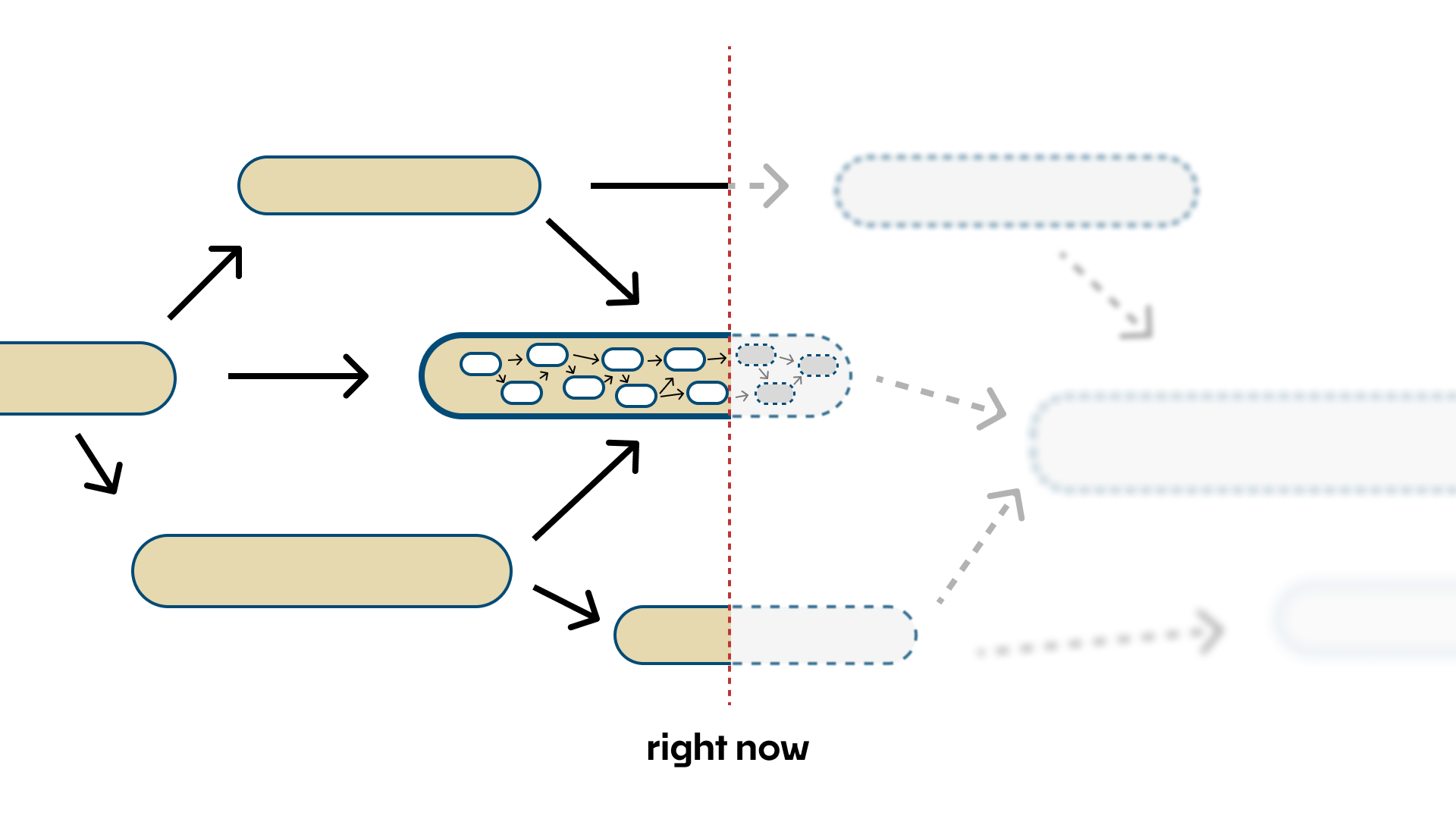
In launching a rocket ship or restructuring payroll, an individual move may be quite large. It is an ordered situation: the move can be modeled across multiple timescales; constraints in the situation are well understood. In adapting how a team operates, or testing new product capabilities in market, an individual move is more likely small. It is an un-ordered situation: cause and effect are obvious in hindsight, though not necessarily stable. Each small move reveals patterns and helps direct attention to those places where the most impactful play is likely.
A future concern, related to the criteria of constructive and enabling, is whether or not the team understands 'what happens next' when the move is complete. More important at first is when the current move ends. A well-bounded move is made deliberately: it is played, and the team learns. Lacking clear boundaries, there is no pause to collect external signals, to practice pattern recognition, or to reflect and adapt. Games that do not define discrete moves and process signals that return, but instead emit a frantic stream of action for the sake of taking action, become increasingly self-sealing as players' perspectives and the actual state of the field diverge.
When you find unbounded moves, you need to close them, and quickly. For a leader, closing down poor gameplay is where the work begins, not where it ends. The team is still unable to formulate a tight move: their unfulfilled ambitions will lead them to try even harder to play that idea, often in one even-more-convoluted move.
Help them shape one good move, manageable and well-bounded. If you can see that their move is not good, you can show them what a good move looks like. Resist the temptation to throw a new framework or operating model into the mix. It's tempting because it appears to offer a solution without requiring a fine-grained understanding of the situation. It's not a grounded move, though it does allow leaders to abdicate responsibility and return blame to the team when, for some reason, telling them to try Shape Up or Continuous Discovery did not yield immediate results.
Start with Initiative
All four of our criteria for a good move ladder back up to the initiative, previously defined as "what [the team is] trying to get done, and what [they're] doing about it right now." Start with the initiative if you are trying to support a team and improve their play — the work logically flows from initiative into the rest of the playing field.
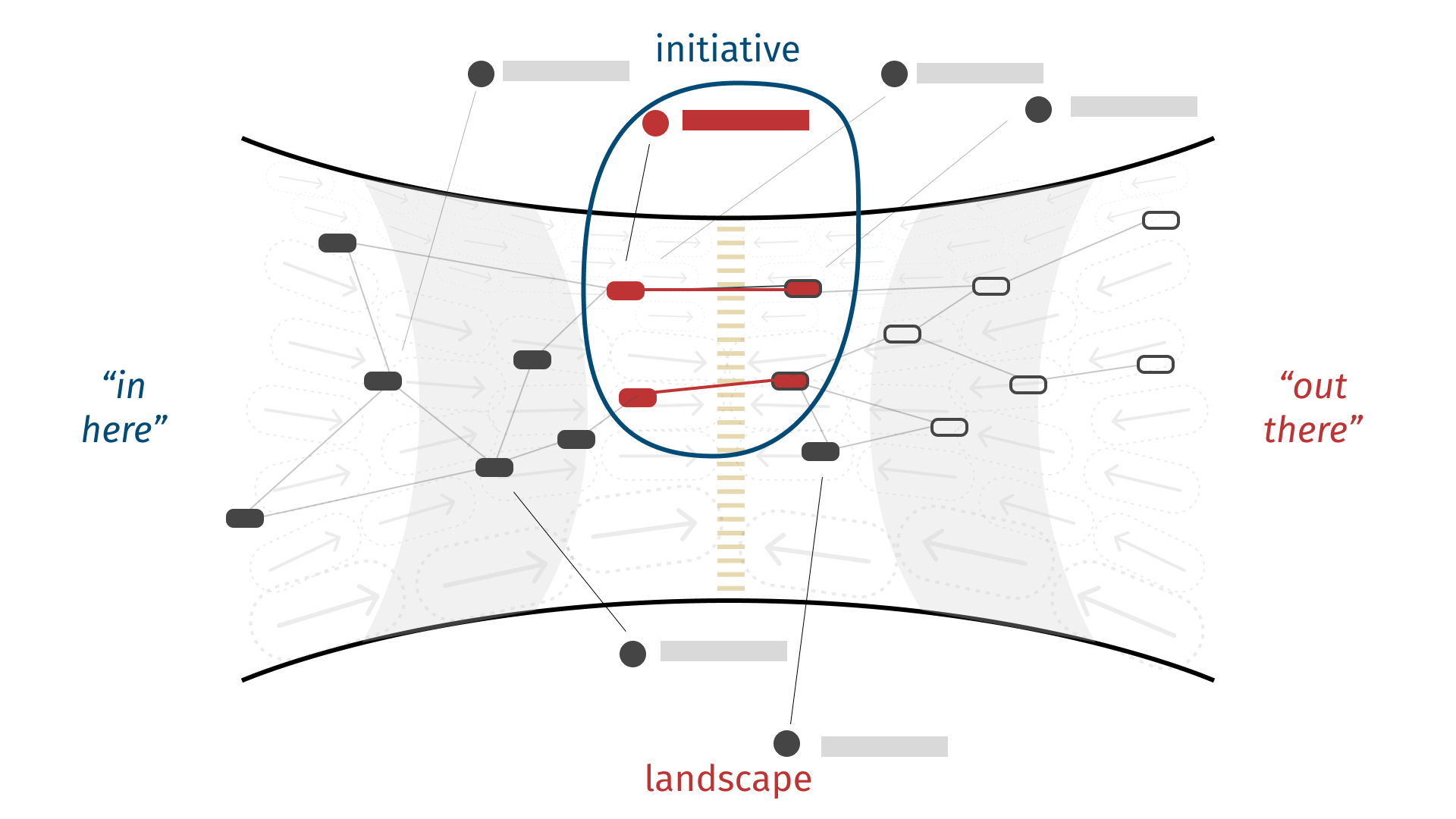
Even if the team's explicit understanding of initiative is poorly formed, it is implicit in the move they're working toward, and the set of steps they are using to get there. Show them.
If the move is not good — bounded, grounded, constructive, and enabling — you're in luck: you have a concrete foothold for repairing gameplay.
Other things of note
- On 'ordered' and 'un-ordered' situations, see the classic 2003 IBM article from Kurtz & Snowden (direct PDF link, vdc.edu.au), The new dynamics of strategy. It's one of the cleaner entries into Cynefin thinking.
- There is an old saying in jiu-jitsu that "everyone was a white belt at some point." True, but it's hard to remember what that was like. Bad coaches and instructors communicate knowledge as they see it without the ability to to recognize how others will perceive it. Good coaches and instructors give manageable guidance that players can practice and internalize, alternating as-required between macro-level concepts and micro-level examples.
Until next time —
This is a newsletter for people in the product org who want to see the game and evolve how it's played. Subscribe to Monday updates, see the index of past posts, or unsubscribe here.
— Dave


