


In product strategy situations — building into new ideas, addressing acute problems, consolidating disparate offerings — there are three aspects you can work with to advance the situation: the game, the gameplay, and the players. We've been alternating among these three major topics. This week, let's look at what it means to work with a game.
'Game' is our frame for any specific strategic situation and the relevant structure beneath it. Depending on who's involved and which perspectives you prioritize, the same situation will be interpreted quite differently. For Player X, certain options for action will not exist because their scope of awareness does not include what Player Y sees as tractable and available. Where Player F sees clear paths and options forward, Player G's rich and fine-grained understanding of the situation shows the high-cost constraints and tradeoffs that F has never before considered.
We touched on this idea a couple years ago in Frame Control, shown below, from an inverse angle. Multiple kinds of frame help players make operational sense of a situation. Rarely does a single view ensure that different players reach a coherent, shared understanding that supports forward progress.
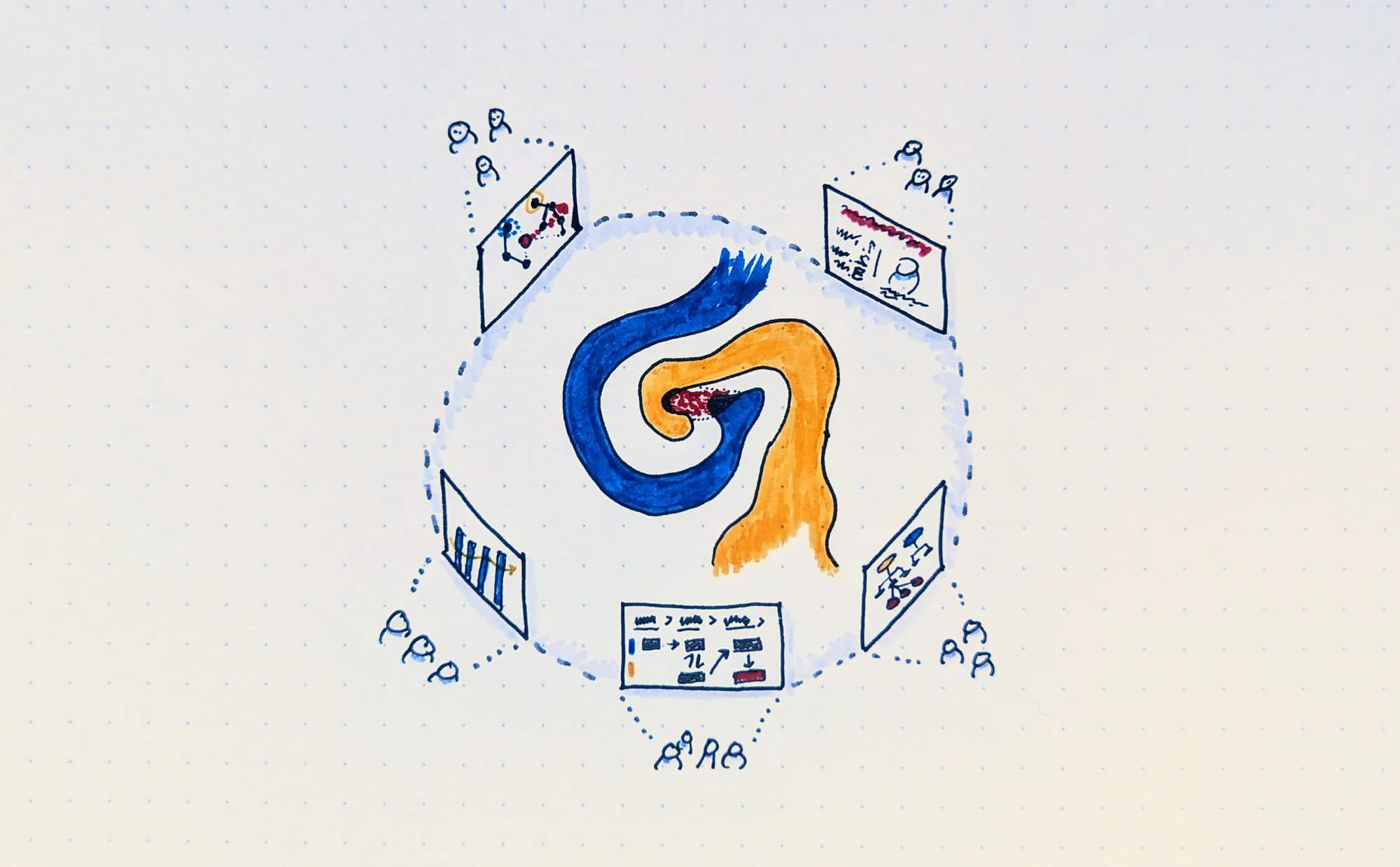
Here, we're talking about one specific kind of view — a more unified starting place. You can use it to build your own snapshot of the game, and you can use it to assess other players' understanding, as well. Before you worry about the right frames for convergence, you work to find where players' understanding of the situation is not converging and not coherent. That understanding will ultimately point out which auxiliary frames are appropriate in order to highlight constraints, blind spots, or critical divergence. (I built an index of some auxiliary frames here, which I'll re-align to the product game framework down the road.)
Three Parts of a Game
Start by exploring the three core areas of the game, as we depict them in product game framework. They work as a basic sequence for exploration:
- Sense for coherence and specificity of initiative
- Identify critical relationships between internal and external structure
- Anticipate situational context and changing landscape forces
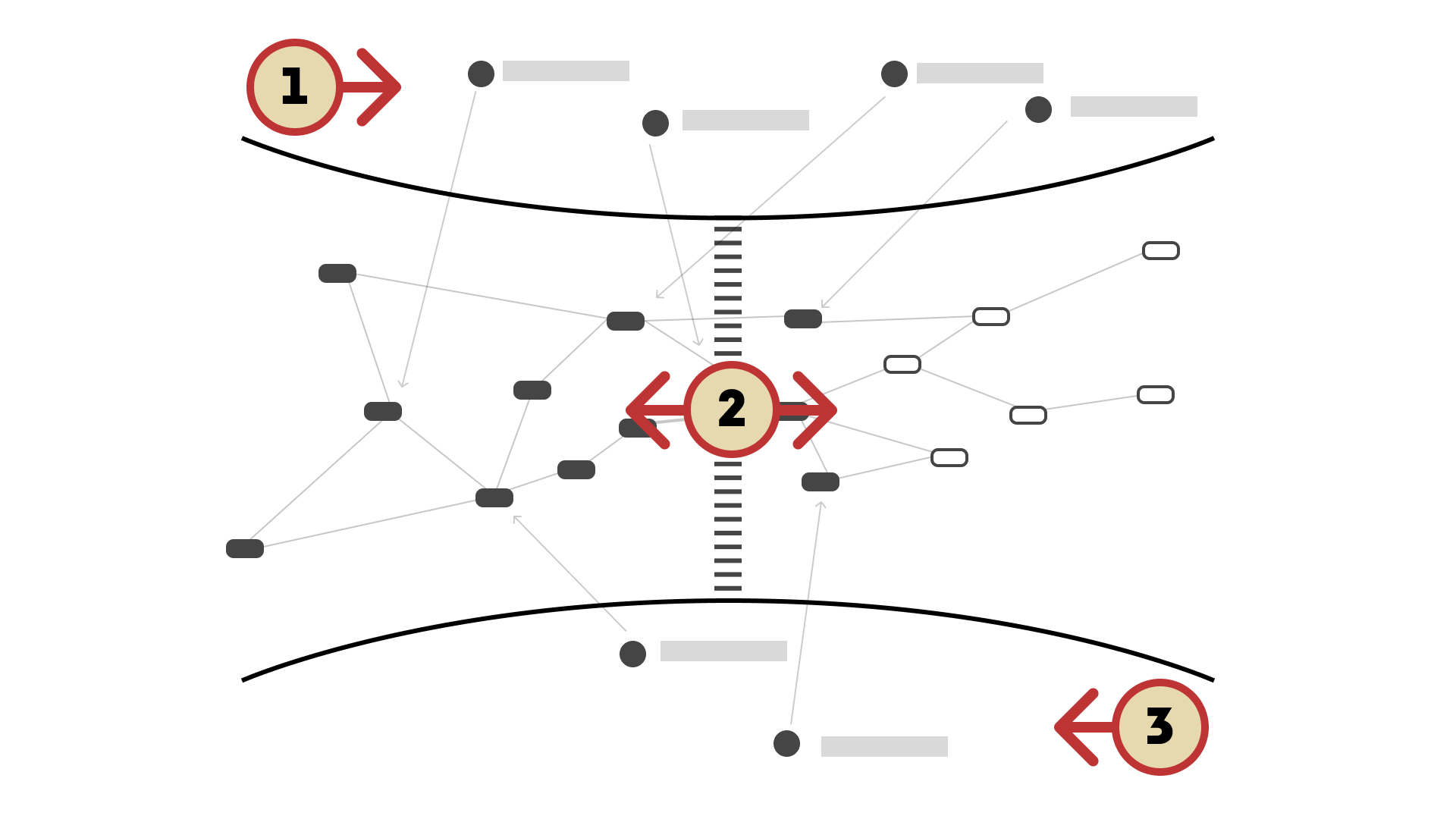
Your first pass is simply scanning through your prior understanding, the initial contacts you have in hand, or however you've been introduced to the situation. Then you can apply more rigor in narrative collection. As you explore further, alternating among the game, the moves underway (gameplay) and others' conception of what they're doing and why (players), you'll start to hone in on the critical parts and relationships of the game itself.
Let's consider these three places, and why you ought to look there. Just thumbnail sketches — we'll dive in with concrete examples down the road.
1. Initiative
Sense for coherence and specificity of initiative
The first bellwether for the strategic health of the situation, initiative (#1 on the image) encapsulates whatever direction and intent are attached to the work at hand. In a healthy situation, there is directional purpose and a clear play that contains some kind of hypothesis about what will be different and better when it's been achieved.
The inquiry begins simply, elaborating on the basic theme of "what are we doing here?" The existence of documentation (human-generated or otherwise), a project codename, or prior conversations are often taken as evidence of a well-reasoned initiative. I used to imagine this kind of thinking was a given, coming into new projects, asking for the basics — what are we trying to do here? who's it for? why is that good? what will be different after we do it? what will we be able to do next? — and expecting that somebody would have a clear idea. More often than not, the first phase of critical strategy work is getting to the point where these questions can be answered with specificity, and looking at how well the team involved shares an understanding of the situation.
2. Structure
Identify critical relationships between internal and external structure
A healthy initiative is clear enough to indicate the specific structures in the game (#2 on image) that are critical for success. There is no blank slate (a good move is constructive), so there is always existing structure that will be modified, or a relationship to be adapted.
The fundamental product dynamic is the interaction between internal structure and external structure; I draw the divide as a vertical dashed line in the product game framework. Start by looking for parity between the internal and the external as you enumerate those things that must be considered in the situation. Internal bias — teams, technologies, methods, offerings — is a sign of weak situational awareness (whereas external bias is the researcher's great sin.) On each side, there are contexts, intents, and actions that need to balance across the divide.
Ultimately, it's not the structure but the critical relationships that drive the situation and situate its gameplay. In a product strategy context, those relationships will exist across the internal/external divide.
3. Landscape
Anticipate situational context and changing landscape forces
The critical structures and the relationships you identify as relevant for the game at hand will change, whether or not you change them. The landscape (#3 in the image) is where you make sense of the forces at play that will affect your actions and options, whether or not you recognize them.
In the classic sense, 'landscape' considers the inertia and punctuated change driven by the inevitable evolution described in Wardley Mapping. It also includes the decision domain characteristics of complexity and order, as described by the Cynefin framework. A bit more practically, it can also include faster-cycle organizational and ecosystem events which you can anticipate and leverage (customer conferences, board meetings, etc.) if not adapt outright.
There's a lot more to be said on each area. For now, we're rebuilding the top-level structure of strategic work as an alternation among game, gameplay, and players — depending on the situation, any one of these may be the strongest entrypoint for changing what actions and outcomes the game produces. We start to work with the game by looking at three areas: initiative, structure, and landscape.
Other things of note
- The last few weeks in jiu-jitsu, I've been working through a specific problem in the front headlock position. Recently, a coach watched one of my sparring rounds and came up to me after class asking, "hey, have you considered this?" He showed me a specific hand placement for the chinstrap grip, and explained how it would change my options with respect to the most likely patterns of opponent reaction. When I tried it, the lights came on — pieces clicked into place and I suddenly saw the larger situation around my problem differently. Technical knowledge hooks onto prior experience. It's a real joy when that hooking-onto upgrades your perception of the experience altogether.
Until next time,
This is Dave's strategy newsletter for product leaders. Find the game, improve gameplay, challenge other players, and scale from strength.


