


In 2016, I was building a research team at PlanGrid. At the time, PlanGrid had strong market traction — a lot of pull from existing customers — and smart, talented leads across the organization with different ideas about what was important. It was difficult to position a research program to support and accelerate critical work.
Depending on who you spoke with, that critical work might be to support extremely specific named-account customer needs; to double down on the larger vision of capturing the construction record-set; to enter the 3D BIM space instead of limiting ourselves to 2D drawings; to build a project-management workflow offering that would solve for submittals and more; to increase on-platform data by improving field-user input experience; to create flexible containers for data partitioning and privacy on sensitive projects; and many other opportunities, perhaps long-felt and often-overlooked.
Producing strategy
At the time, I thought of strategy as fairly static. It was something that we would develop, determine, and depict. All the complexity and all those entrenched and competing perspectives would smooth over once we had “a good strategy.”
My understanding of Rumelt’s kernel in Good Strategy / Bad Strategy (a diagnosis of the situation, a guiding policy for approach, and coherent actions) seemed to suggest that you can develop the three areas and then go on and execute when a "good strategy" is in place. And I have seen Lafley and Martin's Playing to Win used as a kind of context-free excuse for making uninformed decisions and declaring the strategy "done."
Managing strategic coherence
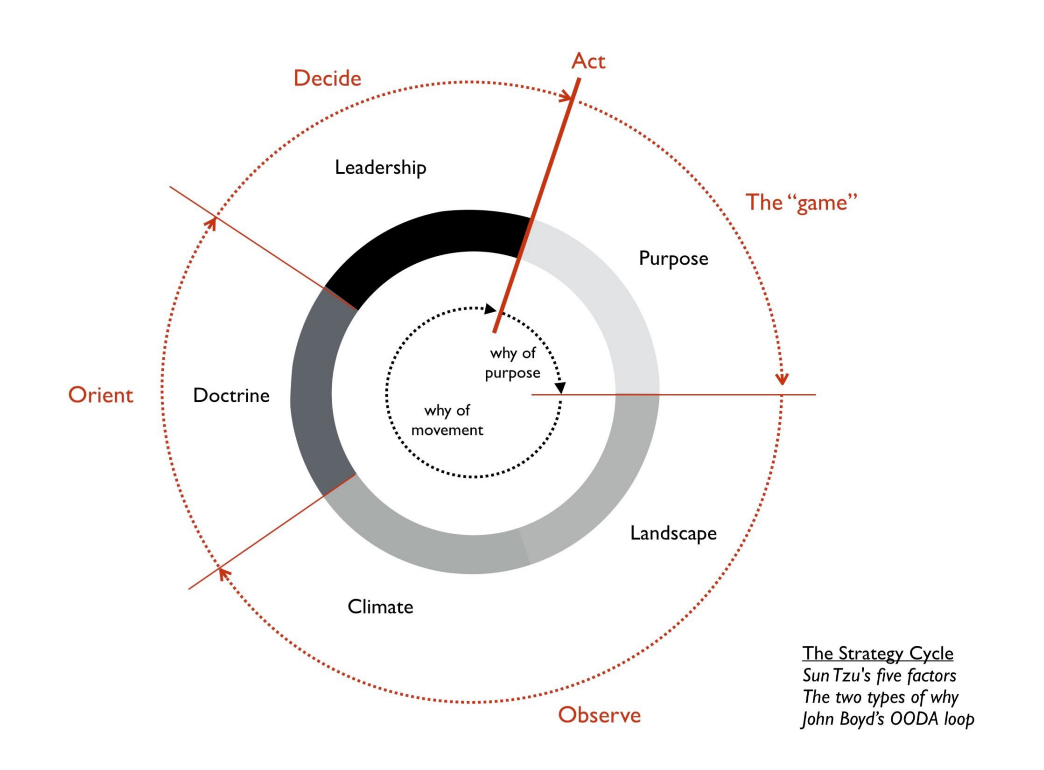
Early on with Wardley Mapping I focused on the map, too. But more deeply considering Wardley’s strategy cycle was the first time I internalized the notion of strategy as an iterative, adaptive, and ongoing process. The map creates a vehicle for situational awareness and collective orientation, but having the map and deciding on the play is not “a strategy.” It’s just one step, observing the landscape and climate, in the ongoing and cyclical process.
My own exploration has been focused on the structure of the situation (game), the moves being played out (gameplay), and how the people involved understand the situation and their available actions (players). Trying to build a coherent frame for strategy, I was still focused on the static descriptors of the situation.
As a strategist, you need to see and identify the critical parts in each of these three facets. The environment changes on its own — everything evolves — and if you play well, your own moves also change the environment. Once you have a rough picture of the situation’s game, gameplay, and players, the work is not in further developing that understanding or depicting the situation; refreshing that understanding through targeted learning and further gameplay is simply the table stakes.
In the following years at PlanGrid, our team became more entrenched in product delivery, and I got more involved in strategic planning. I began to realize that we would never just define and follow a strategy that would make everything work simply. Research could explore and reframe the situation, but it didn't ensure coherent strategy. The roadmap was as much a tool for negotiation between sales, engineering, and finance as it was a means of guiding product direction. And its half-life of validity was short.
The game changed, gameplay advanced, and players' understanding of the situation continued to develop and devolve, converge and diverge.
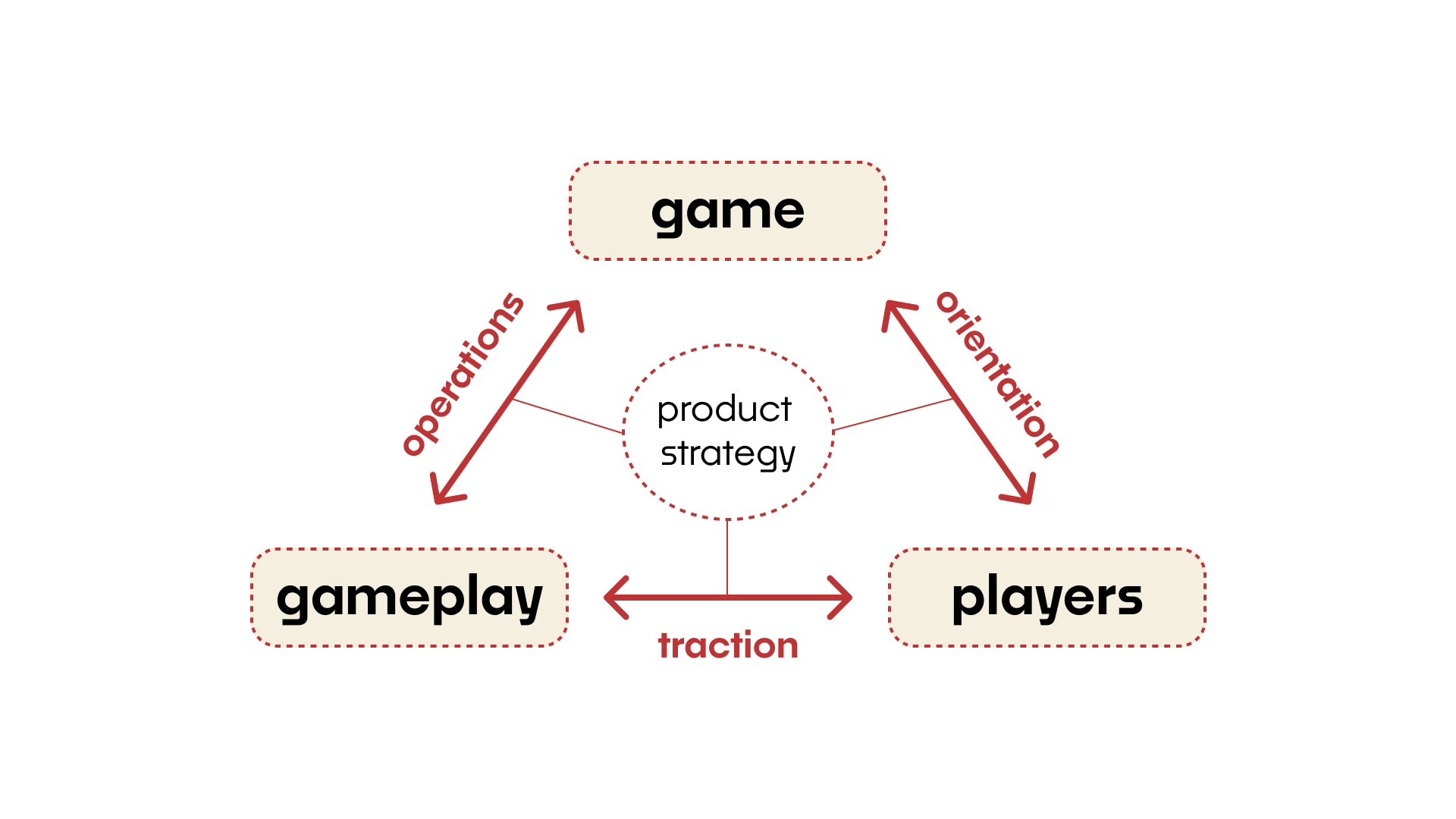
What product strategy really does is maintain and rebuild the relationships between game, gameplay, and players. A strategist must see the game, gameplay, and players, but to do strategy is to make sure those three things are in conversation and mutually informing one another. Healthy relationships between these three are what orient players to the game, inform context-appropriate operations, and create traction in the right direction.
- Orientation is the relationship between the game at hand and the players’ understanding of what is possible and desirable — it’s how work is given meaning, directed, and scaffolded. Do players understand the game?
- Operations is the relationship between the game at hand and the sequence and scale of moves being made — it’s how work is shaped, orchestrated, and evaluated. Does the work fit the game?
- Traction is the relationship between the moves being played and the players’ understanding of what is possible and desirable. It’s how players receive signals from the environment and gain insight that drives their learning. Does the work create better options for play?
Other things of note
- The terminology and the visualization will need some work, but in the context of the Product Game newsletter, I think this is the highest level of abstraction we need to hold the useful parts I've written for this newsletter so far, and its precursor Loops and Cycles. I think this image is more an organization of ideas for teaching, whereas last week's is the napkin sketch to be used in discussing and working with situational specifics. I'll try, as we continue, to re-situate bigger ideas like our problem archetypes and inscrutable play along the lines developed here.
- I'm a fan of both Billy Strings and Bryan Sutton. Live at the Legion is so good. Before I'd heard of either of these great artists, I was a fan of Doc Watson. What a lovely surprise, then, to find that Billy and Bryan had made a tribute to Doc, in the fashion of The Devil Went Down to Georgia. It's here on The Devil Went Down to Deep Gap on youtube.
Until next time,
This is Dave's strategy newsletter for people building product. See the game and shape better moves.


