


Last week (Enter the Game) I described where to approach product strategy situations: by exploring three kinds of structure and the relationships between them. I also wrote about the problems that occur when players or games seal themselves off from reality. We’re missing a head-on look at these product strategy situations framed in a positive context: teams aren’t always stuck or stalling, products aren’t always over-engineered or underperforming, and CEOs don’t always push for inappropriate or out-of-touch directions.
The work is more obvious where there are acute problems. The other side of that same coin is to play where there's latent strength to be drawn out and opportunity to be explored. There is some move at some level of scale that can best elicit that latent strength and allow it to unfold. First, you need to consider what kind of move you need to make.
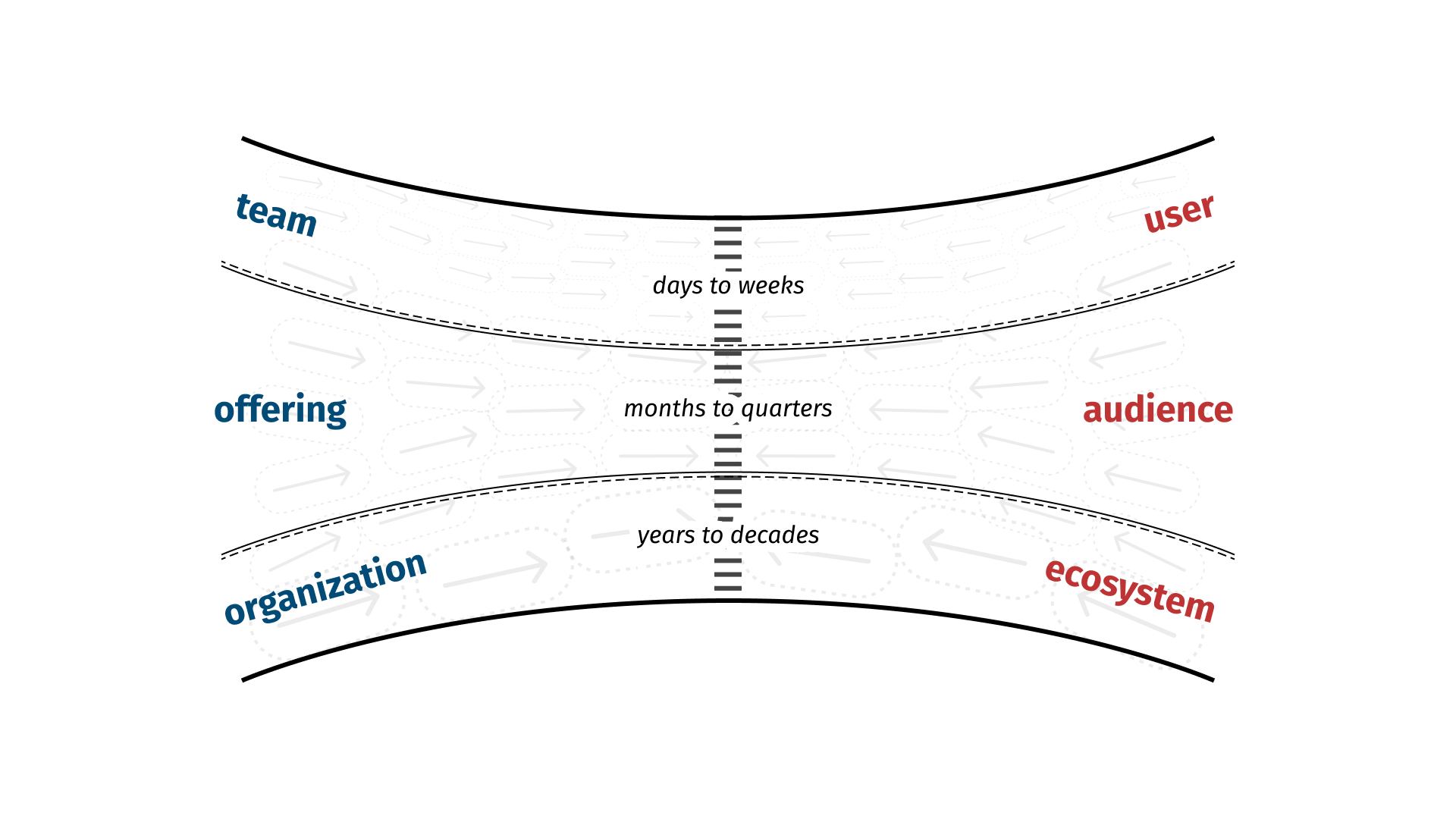
We'll run through some classic moves across levels of scale on the playing field (shown above). Each building block contains predictable and repeatable kinds of steps. To grow as a strategist and a leader, one skill you must cultivate is identifying the right move and sequencing the steps that will allow it to advance given the current state of the game.
Fast Moves: Team ↔ User scale
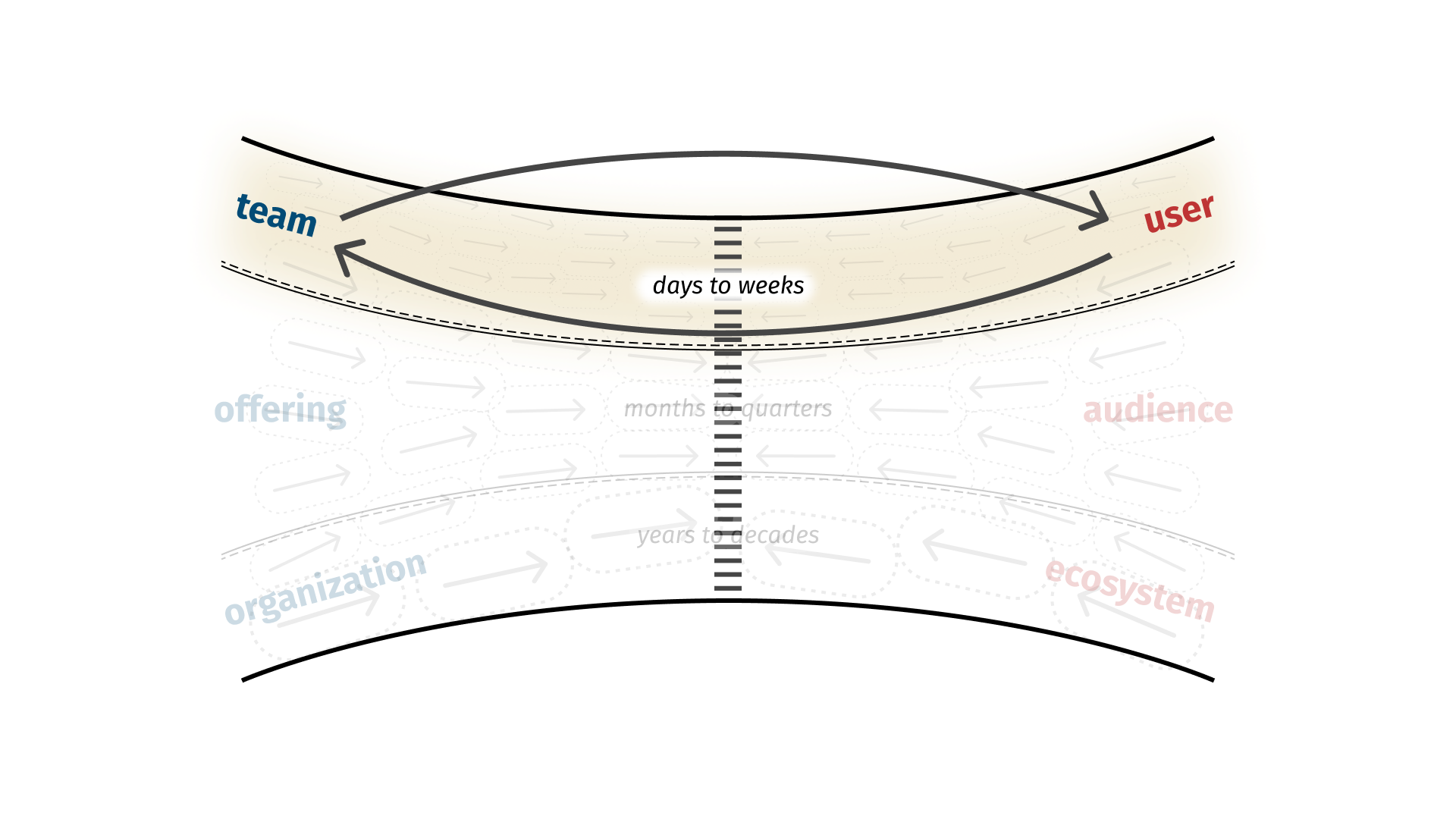
The simplest and most straightforward moves are fine-grained. They’re easy to learn and work with because their scope is small and the cycle time is fast — leaders and their teams can quickly get in repetitions in different contexts, building the sensibility required to drive these moves, even when they arise in previously unseen contexts.
- Repairing broken or unstable functionality
- Improving and extending successful functionality
- Evaluating performance and demand for existing functionality
- Delivering novel feature capabilities
- Removing or rescinding undesirable functionality
We can consider this scale the entry point for junior-level practitioners. It’s an entry point that seems to be closing as LLM tools are increasingly used to drive wider scopes of functional work — design, engineering, research, and even product. How this work is undertaken and who is involved is no longer stable, and it’s easy for teams to make the mistake of over-emphasizing moves at this level of scale, building much more, simply because it is possible, overlooking the build towards slower-scale moves and considered, long-term play.
Middle Moves: Offering ↔ Audience scale
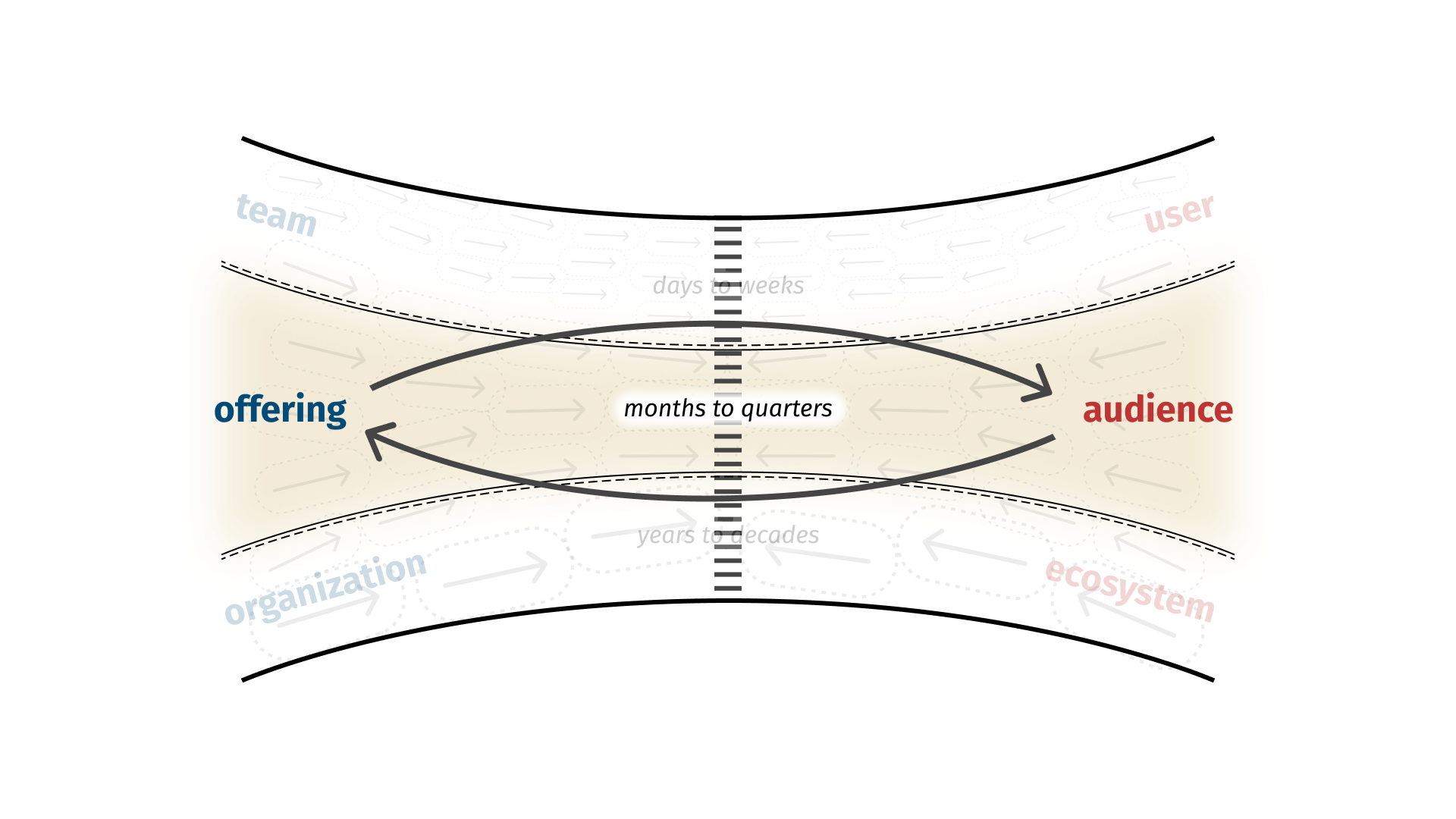
The first five moves in this scale are classic product-strategic building blocks. They’re similar to the moves that one team will take on, but they operate on a wider scope of user segments, internal structure, and external product surface area. Again, each move here must adapt to its organizational and audience contexts, but the critical kinds of steps that will make them successful are predictable.
- Consolidating existing product in existing market(s)
- Delivering a new product line into an existing market
- Delivering an existing product into an adjacent market
- Re-structuring product pricing and tiers
- Sunsetting a product area
Historically, learning to lead at this level of scale has been built on experience at the faster Team ↔ User scale. The tacit knowledge built from driving sequences of work in more fine-grained moves is what enables leaders to grasp and grapple with the trade-offs presented at this wider, slower level of scale.
There are, of course, many other kinds of moves that live at this level of scale — you need to be aware of them, and be able to plan for them and balance them. Here I don’t consider function-specific maintenance like infrastructure work, design system deployment, or GTM work like shifting from a sales-led to a product-led motion. They’re just as critical. I take them as specialist moves for now, occurring more rarely than the major building blocks.
Slow Moves: Organization ↔ Ecosystem scale
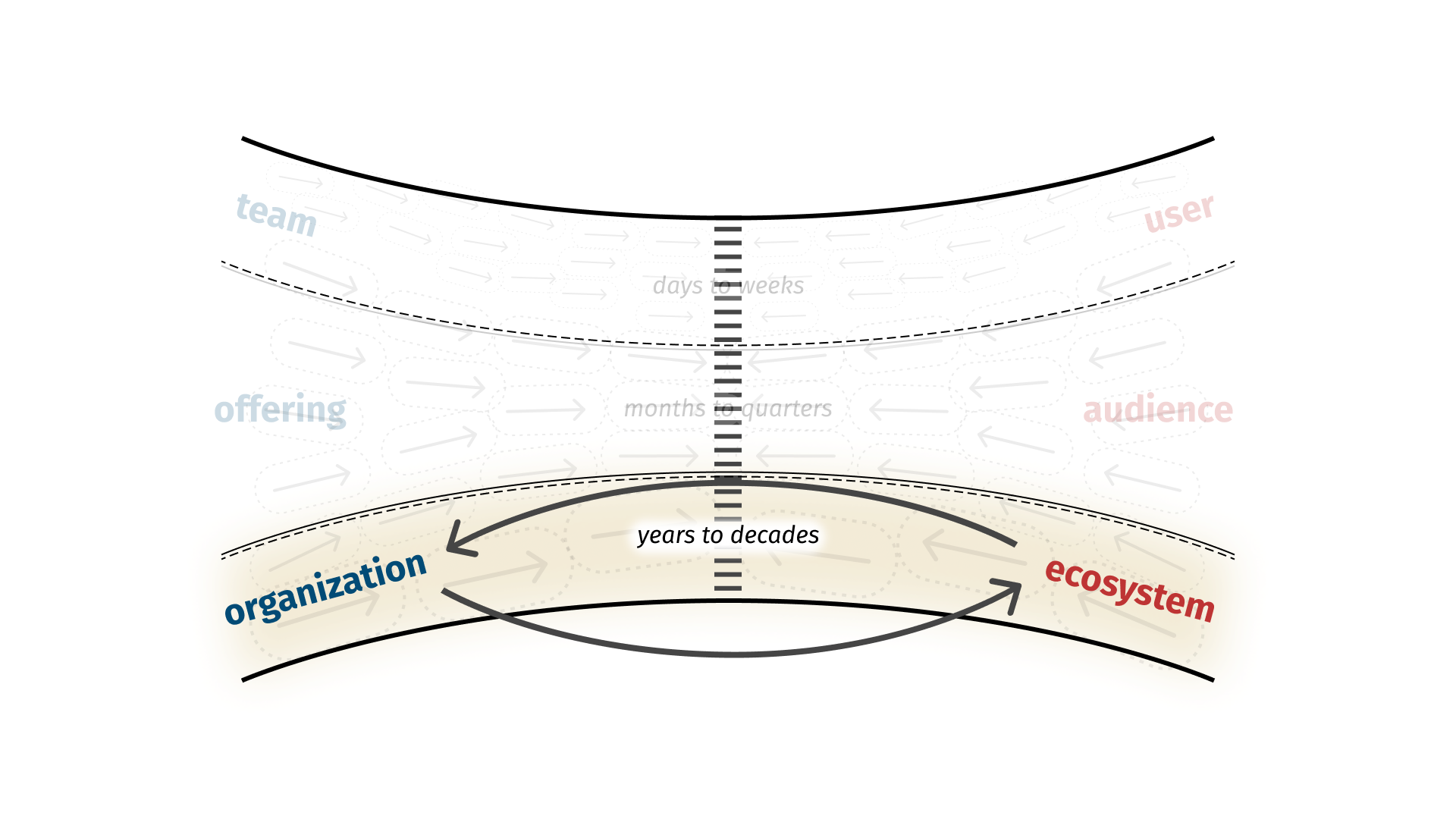
Even on the largest and slowest scale, the building block moves tend to mirror those at the middle and faster scales, though they are driven by board concerns and executive plans more than the product organization’s capabilities.
- Consolidating share of an existing market
- Launching a new venture or division
- Competing in a new market segment
- Re-structuring product packaging or business model
- Integrating acquisition into the portfolio
- Divesting existing product area
Growing into larger-scale play requires adjacency: there are visibility barriers between each major level of scale. A player whose work is focused on the Team ↔ User scale will not have meaningful visibility into the work happening on an Organization ↔ Ecosystem level. They use different language, they pay attention to different signals, and they will have a hard time connecting their work to the moves at the slower and larger level… no matter how tightly bound the OKR cascade appears to be. (Note that some activities like capital events are designed to be opaque and invisible, even within their timescale.)
Basic Strategic Building Blocks
As a leader and strategist, whatever your primary level of scale, you must be able to drive those kinds of moves forward deliberately before they can be deployed in more complex, strategic sequences: it’s gameplay before strategy.
A move at any level of scale can still be strategic or un-strategic in its execution. Players — especially leaders with a past track record of success — will shape play based on an internal feeling of possibility rather than the reality of what the game presents. Where these moves are undertaken for their own sake (not enabling, for example), they preclude the pursuit of unexpected opportunities and meaningful learning and feedback.
Where there is a sensibility for learning and process — where you attempt to shape the best well-formed move to advance the situation — you can find and examine the internal operating structures, cycles, and expectations that drive the success or failure of the right move. You will learn from the game at hand and continue to build knowledge of the game's critical enablers and constraints. Understanding how to play a move, and having a feel for the effort required and the nature of its output is necessary to consolidate your understanding of play towards a larger scale, and to sequence more complex multi-move strategy.
Other things of note
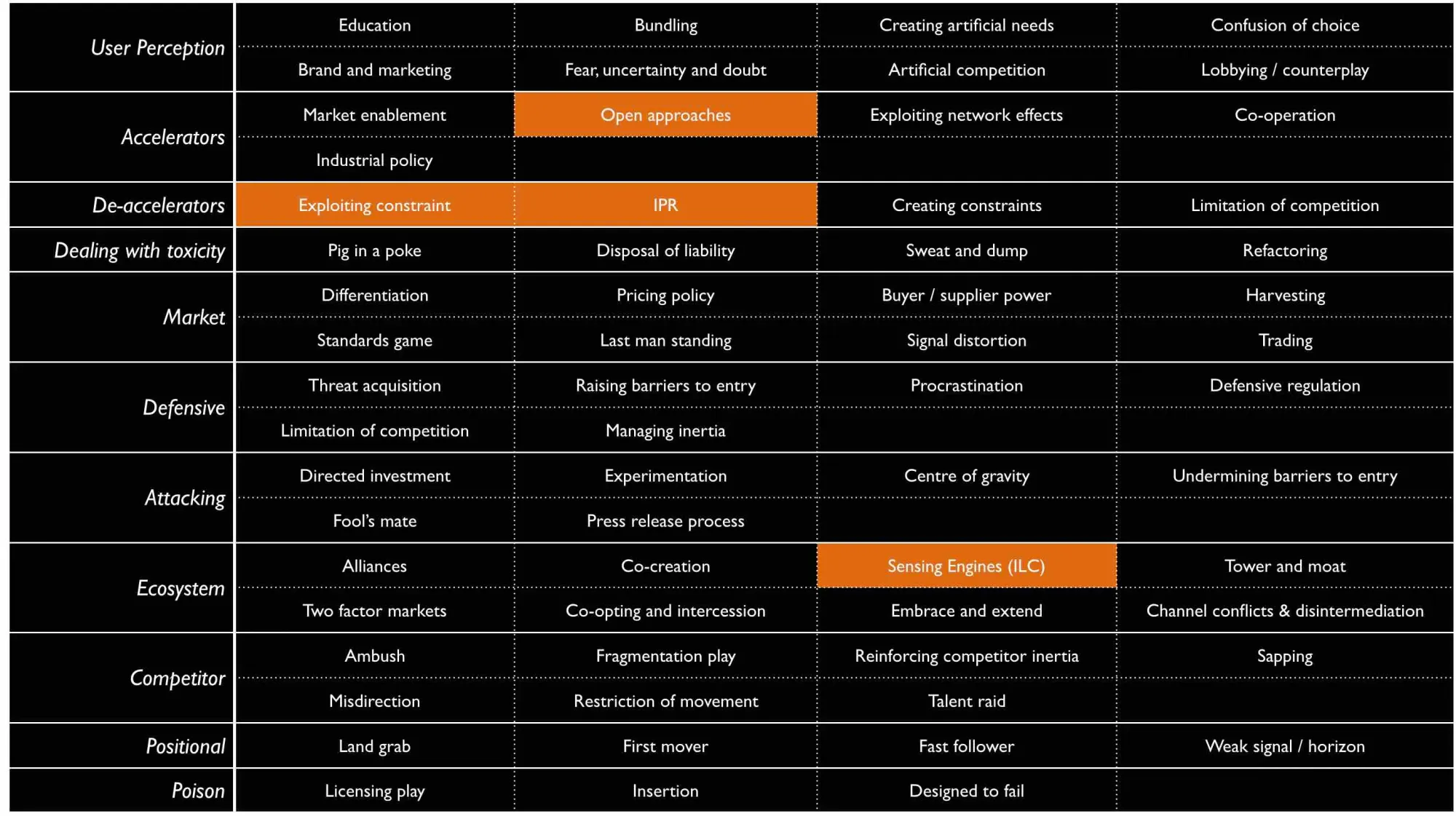
- I consider Wardley's gameplay the best current source of higher-order strategic thinking... but first you need to learn to play the game. You can't run Innovate-Leverage-Commoditize if your team can't successfully leverage insights about capabilities and create a new product offering. There's an index here, and I don't know the best single-source for learning the gameplay outside of the ebook. Here's a table listing all the different kinds of play:
- Rule Number One, my first wine, is released. See some behind-the-scenes photos on instagram.
Until next time,
This is Dave's strategy newsletter for people building product. See the game and shape better moves.


