


When the CEO proposes play from a self-sealing game, it carries a defensive veil, radiating out to the faster timescales. Whether or not that idea is good — there's often healthy intent coupled to over-specified and poorly-timed play — it will disrupt ongoing work until it's proven out in a satisfactory form, or somehow put to rest. To approach the game, you need to understand its defenses.
This week, I want to separate self-sealingness in game from the strength of its defense, which can turn it truly problematic. Last week I said:
Now I consider a self-sealing game the singular, archetypal class of product problem, from which every other problem stems. A game is self-sealing where the incongruence between its theory and its action is visible, but protected from intervention.
We've touched on this theme before. It appeared as self-fulfilling projects and then showed up as the first archetypal problem in the four horsemen:
- The self-sealing narrative (attachment to untested/untestable ideas)
- The treadmill of stagnation (inability to admit / attachment to a wrong turn)
- The death-grip of success (attachment to a previously successful direction)
- The autoimmune response (attachment to previously successful action)
The issue with my prior framing is that each of the latter three situations may also be self-sealing. And an ungrounded narrative, if it is receptive to feedback from the context of play it targets, need not remain self-sealing. I went on to say:
The other kinds of problems that product leaders and their teams fall into — blind pursuit of poor ideas, inability to recognize a wrong turn, over-investing on past success, or the inability to adapt ways of working to changing conditions — are all instances of self-sealing gameplay.
So each of the four archetypes are, to some degree, self-sealing. But what determines whether a game is merely misguided or perniciously self-sealing? Here, we need to consider the strength of its defenses.
Self-Sealing Games with Weak Defenses
When you work with a misguided game that has weak defenses, and attempt to nudge its primary players into a more sane direction, weak defenses do not directly oppose new options for play. There will be resistance to change because inertia is inevitable, but the resistance itself does not change shape to match the challenge.
If you can show players a path to improve the play inside their current constraints (make it more grounded, bounded, constructive, or enabling), they will follow. If you can alleviate the interaction of games and the constraining conditions that created the trap, play will open to fill the new possibility.
Direct interventions from leadership — formal organizational structures, pressures, strategies, and expectations — create unexpected consequences. Sustained, high-pressure development fueled by LLMs increases the chance that teams fall into directional traps. It's easier to get structure in place, whether it's strong or weak, than to remove what is weak, or build a strategic case for what should exist and what should not.
Self-Sealing Games with Strong Defenses
When you work with a misguided game and attempt to nudge its primary players into a more sane direction, strong defenses create a pattern of continued and increasing resistance. The resistance changes its shape to meet your angle of approach.
If you can show players a path to improve the play inside their current constraints, they will argue for the strength of the current play, and challenge you to prove you understand its strength; they won't respond to the weakness you raise. If you try to chase down the interaction of games and constraining conditions that led to the trap, you'll encounter unknowns that conceal themselves: they can be felt and interpreted, but cannot be openly discussed.
Personal investment and ownership is a strong organizational force. Misguided play, from your perspective, is potentially face-saving, career-boosting, or personally enriching play inside adjacent games you don't see. Trying to repair or remove the damage from these games is an infuriating round of Whac-A-Mole with potentially personal consequences. If you exert energy to redirect a self-sealing game with strong defenses and fail, you are sealed out and recognized as an enemy of its intent. (Depending upon the game at hand, that condition may be desirable.)
Timescale and Defense
The difficulty with defenses in self-sealing games is that slower timescales are inherently protected from the faster ones.
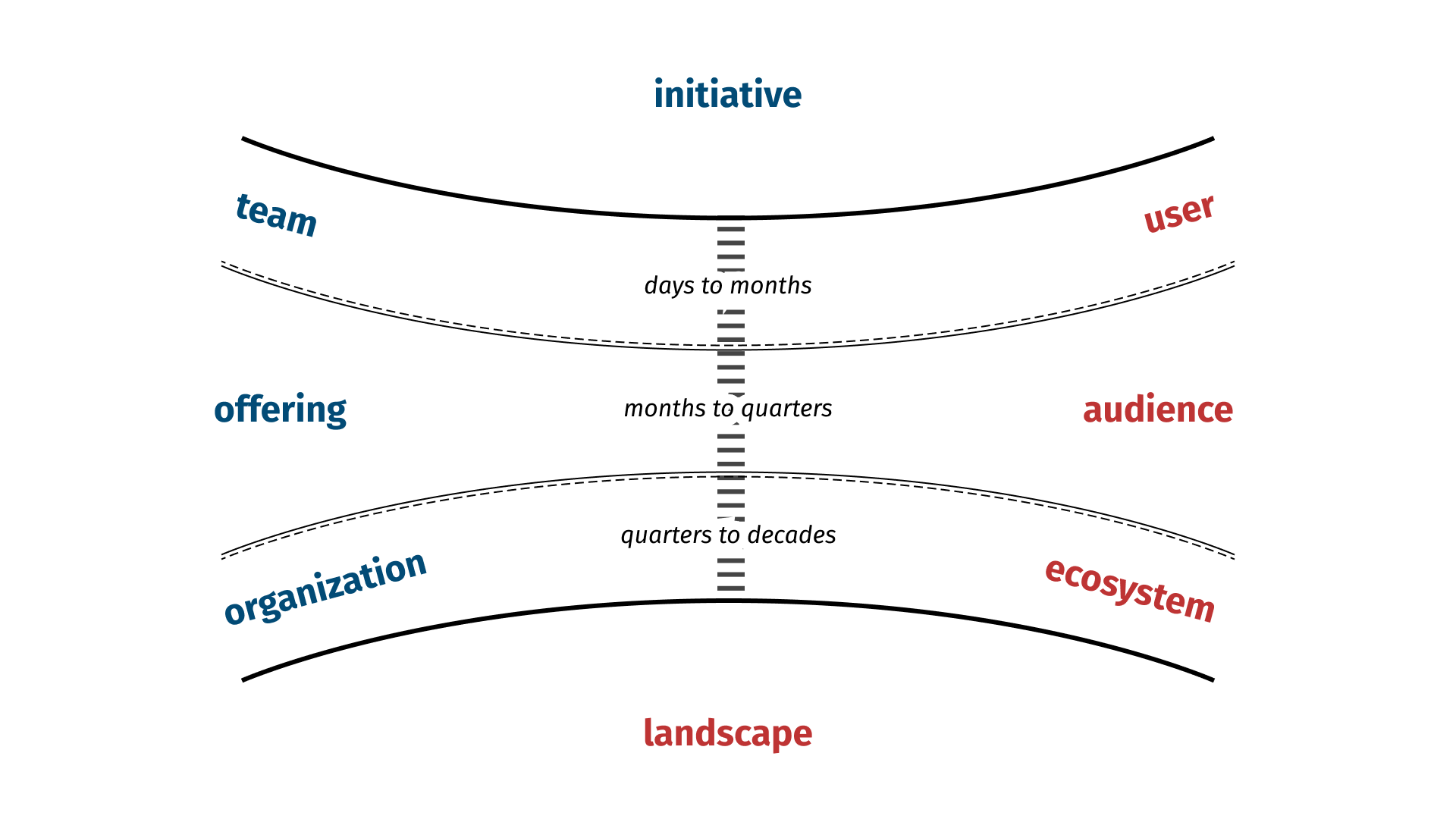
Players with authority in long-term, slow-cycle games directly shape and alter the conditions of faster gameplay. Players with authority in short-term, fast-cycle games send signals into slow-cycle games.
Consider the CEO example. Assuming the idea is one that should be put to rest, there are many angles of approach, if you consider the relative timescale.
- Slower: You appeal to even-slower timescales, say, connections in the board.
- Direct: You fight against the play head-on, in order to expose the strength and shape of the game's defenses.
- Inside: You pierce the veil from the inside, building trust and using the game's own language to expose its strengths, weaknesses, and its true potential value or self-defeating nature.
- Adjacent: You exert pressure through adjacent players who have direct access to the game, like other members of the C-suite.
- Faster: You can coordinate a quorum of faster-cycle games to send a corrective signal or effectively block the play.
The decision to engage, and how, is meta-gameplay: moves that target organizational games. I like the inside play for exploring the strategic value of the self-sealing on its own terms, attempting to establish trust and common language, nd to satisfy an anthropological curiousity about the conditions that led there. But that's not always accessible, and won't be easy if you've already taken other approaches.
Other things of note
- Teams shaping well-formed play are capable of generating traction, and ready to orient on strategic direction. Self-sealing games with strong defenses resist acknowledging evidence from the field of play. They generate the opposite of traction: strategic debt.
- I'm thinking about complexity, constraints, and garbage collection in the organization and through the lens of fire in the natural environment. I started listening to M R O'Connor's Ignition. She discusses evidence that humans have shaped the natural landscape and wilderness, for tens of thousands of years, with fire. She raises the concept of fire debt. In contrast with indigenous land management, modern society does not understand where, how, or why to burn. We lose prairie and meadow and environmental complexity, and create the conditions for devastating conflagration instead of continuous maintenance and renewal.
- I also enjoyed reading her Wayfinding, which explores how humans orient themselves in the natural environment. Besides being an interesting read, it's helped inform how I think about contextual awareness and traction.
Until next time,
This is Dave's Monday newsletter for leaders in the product org: make good moves, help others play, reshape the game.


