


Strategy in the form of long-term plans does not serve teams well in the current context of product work. I'm not speaking about long-term direction, which is critical. And it's not universally true that detailed plans are a bad idea. If you're building rocket ships or restructuring rigidly defined payroll workflows — any kind of project considered in How Big Things Get Done — you're gonna want a plan.
Most product work doesn't work like that. Productizing emerging capabilities is an attempt to create viable structure in an uncertain and rapidly-changing environment. Yet product planning so often assumes a level of order and stability that doesn't exist. The more structured and detailed the plan, the less it can account for its own short half-life of usefulness.
Nonetheless, you plan. A plan is produced through hours of performative process theater or the generation of slop-docs whose collective breadth is too large for anyone to absorb. Where long-term planning is unsuitable yet inevitable, teams default to protecting their existing momentum and maintaining the resources they already command. What results is something that may capture current momentum — or worse, prescribes static steps — but defers coordination over critical tradeoffs. It does not anticipate how the situation will change as teams step their moves forward and external players everywhere do the same.
And then the planning process is over. Team leads rebuild momentum after a torturous interruption, and parts of the plan shift to irrelevance as they find places where its assumptions don't hold.
Where teams have traction, the plan becomes an afterthought. They play forward move-by-move. They receive signal from their play and maintain a strong awareness of the field, making progress towards the strategic direction. Leadership does not consider or evaluate the plan, so long as progress is visible. Team leads wonder why any of that planning process was necessary in the first place, and further resent and disengage from it the next time around.
Where teams don't have traction and can't show visible progress, suddenly the plan is paramount. Leadership insists: the product plan is enforced, shackling team leads to what they've agreed to — which may not be viable. The team needs to re-evaluate the situation and their current approach to find a better path for play. Under pressure of the plan they continue to try what isn't working, now with more intensity and desperation. Team leads wonder why any of that planning process was necessary in the first place, since it didn't put them on a useful path, and now prevents them from finding the right options for action.
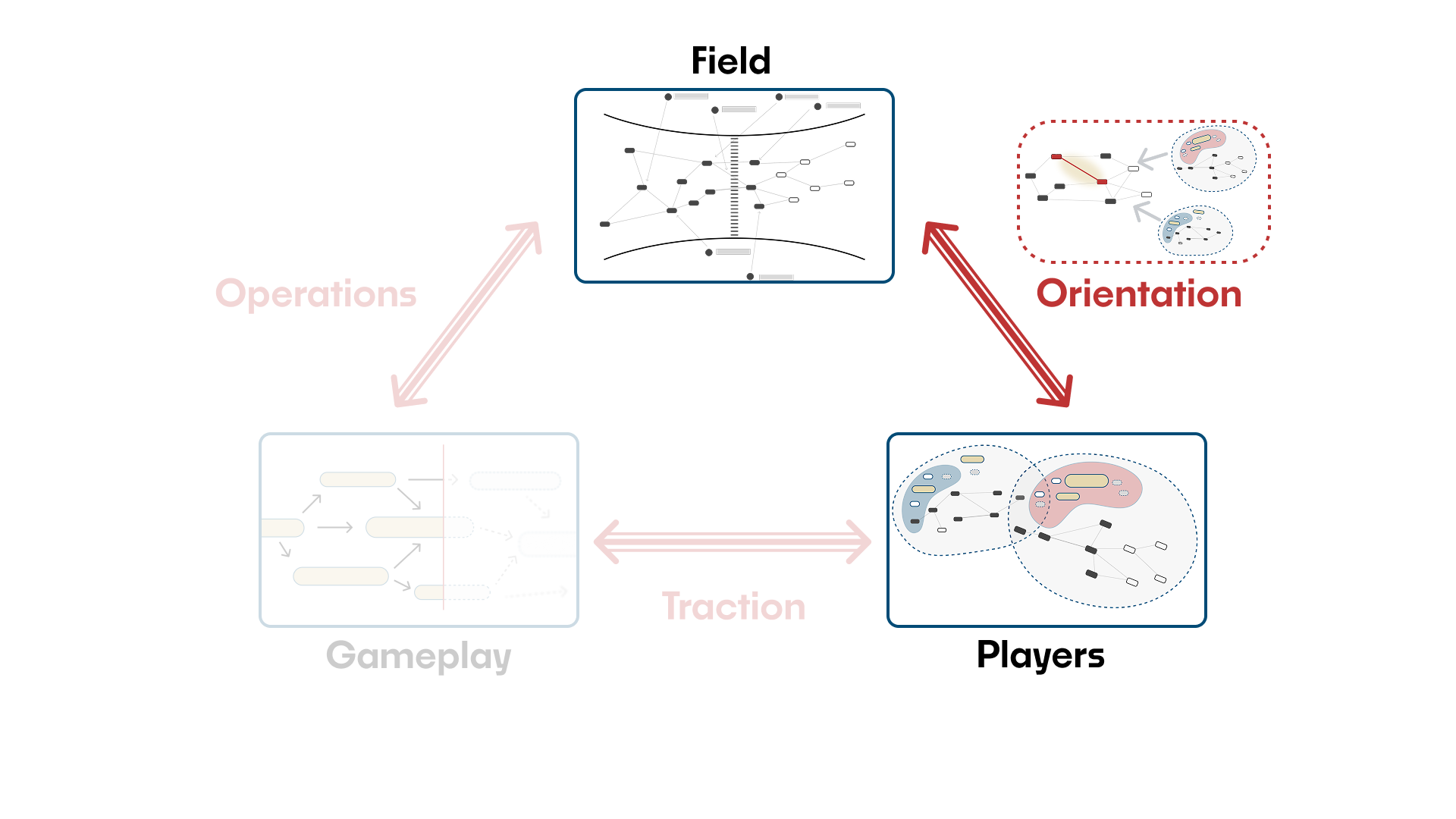
Back to How Big Things Get Done: in well-ordered contexts, the kind of plan that gets developed dictates the structure of gameplay. It develops the sequence of steps and the shape in which they will be played out on the field. This is the same kind of plan that, for software product work, becomes irrelevant, disregarded, or stifling.
Software product situations need plans that orient. They work to create a shared language and understanding of the playing field, so that players can identify and debate about the tensions that exist and will inevitably arise. When effective, and where necessary, the plan is a flexible scaffold for building forward. You create structure that guides and enables healthy gameplay by orienting players toward the state of the playing field.
Dave Snowden writes about scaffolding as part of a seed–scaffold–propagate trialectic on the Cynefin blog:
To scaffold is to provide temporary structural support for something that is beginning to stabilise but cannot yet stand alone. The scaffold is not the building. Its purpose is to hold space for emergence without locking it in, to support coherence without imposing uniformity. The scaffold comes down when it has done its job. If it does not come down, it has become the building, which is a different problem.
Good planning is an orienting function that enables teams to play effectively within their own game, while also anticipating play from the games adjacent to theirs. It should create a collective language for coordination, and ensure that, together, those teams are playing toward a larger, higher-order building block.
The metaphor of scaffolding is instructive: the purpose of erecting scaffolding is never to produce a scaffold. It enables the hard work of building to advance smoothly and effectively. The purpose of the planning process, all too often, is to produce a plan. If it's not enabling your teams to play smoothly and effectively — what value do they gain from engaging? The nature of gameplay should dictate the nature of the planning process. Within a given game, two or maybe three moves can be predicted in advance, and then the state of the field is far enough removed from the plan that it's not scaffolding anything relevant.
Consider your current plan:
- Purpose: Scaffolding or blueprint?
- Relevance: If you deleted the plan tomorrow, which teams would even notice? Which teams would move faster? Which teams would suffer?
- Scope: How many moves does it cover?
- Expiration date: How long is it — or was it — valid?
In uncertain environments, a good product plan doesn't dictate what gets built, but enables what is recognized as valuable to emerge. It gives teams something to push against and orient on. And its lifespan is understood in advance: it serves a specific scope of building, and then it's taken down.
Other things of note
- We want bamboo scaffolding, not steel structure. Listen to a great 99% Invisible episode featuring bamboo scaffolding: Bamboo is Innocent. And from the same entry as above, on the Cynefin blog:
Steel scaffolding is rigid, relatively easy to assemble, and removed once the structure is complete, the most familiar form, and the most limiting when applied to complex situations. Bamboo scaffolding is less rigid, requires greater craft skill to create, and is more flexible, but is also designed to be removed.
- I'm halfway through the Maude translation of War and Peace. I didn't know what I was signing up for a month ago: I decided to read after learning it spanned the events depicted by Minard's famous graphic of Napoleon's campaign into Russia. I've just reached 1812. It took some effort to get the characters straight but the reward is rich. Tolstoy builds characters with insight into human urge and instinct that snaps them into living view. Every moment in the novel carries the complex tension and freedom of life: in theory, anything seems possible; with hindsight, the outcome seems inevitable.
Until next time,
This is Dave's strategy newsletter for people building product.
See the game and shape better moves.


